Tennessee Mountain Stories

Garden Mystery

Well we’ve come to the time of year when fresh garden vegetable abound.  Now, I’m not a very good gardener.  I was working in the garden a couple of weeks ago and thought to myself that I’m glad my Grandpa couldn’t see the poor potato patch I’ve raised – he’d just shake his head; he wouldn’t say a word but I know that he would be thinking that I might starve to death this winter.

Squash Plant.jpg

But that fear that my family will hunger drives me to keep putting out a garden despite my poor skills.  And this year I did it again.  My favorite garden vegetable is Squash – as I’ve mentioned here before.  And I try to plant it several times so it keeps producing until the harshest of frosts.  This year I opened a packet labelled with a beautiful yellow squash on the front and planted a few hills.  After a few days of heavy rain they were well sprouted but had washed out of their place and were growing between the rows.  I moved a few but decided I could work around the rest.  I was mistaken.

As the plants grew I knew they weren’t squash because they put out these great long runners.  Could I have mistakenly planted cucumbers in those hills?  Not to worry, I love cukes too.  Then the leaves broadened and I knew they weren’t cucumbers.  Then the melons set on looking like those crook-necked squash I’d hoped for.  However, they were quickly striping-up.  Now I have huge plants – in fact they’ve taken over that part of the garden and I’m having to fight them back just to gravel out my pitiful potato patch.  We’ve been calling them the “Squash from Planet X” because they  look like something from a science fiction movie.

Squash Mystery fruit.jpg

I’m hoping y’uns can help me out in identifying them.  I’ll try to use them but I don’t know how until I can identify them.

This mystery makes me think about the generations of gardeners and farmers who had no opportunity to go to the local Farmer’s Co-op and buy a package of seed.  Instead, they carefully saved seed from plants they marked early on and left to fully mature.  Seeds were placed on a newspaper and set in the sun to dry out then stored in an envelope – or just wrapped up in that paper and carefully labelled.  Sharing seeds with family and neighbors was the sweetest of gifts and a favorite variety of beans or tomatoes were guarded like the most valuable treasure. 

Do you think anyone ever failed to label an envelope?  Or got a seed-present from a friend but didn’t get a good description?  Did any of those master gardeners ever face this mystery, wondering what was going to grow and what they’d do with it in the end?

And would my gardening abilities improve any if I didn’t have a reliable food supply network and I knew I and my family would be hungry if I didn’t raise enough food and didn’t store it properly?  Yeah, I’m pretty sure I’d be better at it in that situation.  In fact, I recognize that time is my biggest enemy in the garden.  There are too many things making demands of my time and the garden often falls too low on the priority list.  If my existence, or even my wintertime comfort, depended on it that garden would surely be more important!

The Rolling Store

A Public Domain image of a Rolling Store.

A Public Domain image of a Rolling Store.

We’ve talked here before about transportation on the mountain – cars were much slower to make their way out here and really weren’t common until after World War 2.  Well families were accustomed to relying on the land as well as their own sweat and ingenuity to survive.  Still, there were exotic things, like coffee, that one easily became accustomed to and conveniences, like flour, that drew you to a store.  Well there’s a dilemma!  You want something from the store but the store is far away (Crossville or Monterey’s 20 mile trip was an excursion when traveled on roads paved primarily with mud) and you haven’t much way to get there.

Enter the Rolling Store.  What kind of entrepreneur must have come up with this idea!  Well mountain men can’t take credit for it I’m afraid for the tradition of a store coming to remote locations goes way back to the Old Testament – after all the Ishmaelites to whom Joseph’s brothers sold him would have been a sort of pack peddlers as they were headed to Egypt selling spices.

Well, on Tennessee’s Cumberland Plateau where roads were slow to grow larger than a good path and automobiles were far beyond the reach of the poor farmers a visit from a pack peddler and later from a rolling store was a much anticipated blessing.

The last pack peddler I know of came through about 1950 from Hartshaw Cove.  He broke his travel at the Stepp’s house in Martha Washington and for their kindness he left my Grandpa a pair of tin snips that he held onto the rest of his life.  (Of course we couldn’t lay our hands on them when I needed to take a picture!)

Clarence Elmore became his own sort of pack peddler selling Watkins Products.  These high quality flavorings were prized by the fine cooks on the mountain and Clarence regularly walked from his home in Roslin to make rounds visiting his customers.  Now, he was my Grandma’s second cousin so she was always glad to give him a bed for the night if he came along too late in the evening.  And of course he’d share supper – and he carried his own spoon so he really wasn’t any trouble a’tall!  Maybe Clarence is another story…

Of course pack peddlers were quickly replaced by rolling stores as soon as vehicles were available.   Well into the 1950’s Pa Evans and Harve Stephens made weekly visits supplying flour and coffee, sewing goods and candy. 

Mr. Evans had kept a store in the booming coal town of Wilder.  When the mines began to work out he moved the business out of that holler to Grimsley where he built a large 2-story store building.   His clientele must have changed a great deal when he moved out of Wilder’s village environment where the coal company had setup housing as close together as possible.  In Grimsley, homes sat on farms and were scattered far apart.  So he took his merchandise on the road to visit those homes with his rolling store.  He even had cages attached to the back of the truck to hold the chickens he would take in trade.  He would also buy eggs.

Harve Stephens store was in a bus and the noise of that engine was unique on the quiet roads.  You could hear him coming for miles allowing the excitement to grow.  Everyone remembers eagerly awaiting the rolling store’s visit.  My Great-grandma would save her eggs so her youngest daughter and oldest grandchild could go on the store and buy candy.   With no such thing as an ice cream truck, getting peppermint sticks off the rolling store was an unparalleled treat. 

Most farms still raised all their corn and had meal ground at a local gristmill.  However, the mountain didn’t support much wheat farming so flour was often requested from the visiting merchant.  And coffee – as I mentioned earlier that’s a luxury Americans quickly adopted and mountain folk were no different.  Sugar was another near-necessity that was delivered along with fresh fruit if you could afford it.  Really anything a home of the early 20th century needed which could not be grown on the mountain could be gotten from these weekly visits of The Rolling Store.

All of the scents of fruits and spices mingled in the confined space to create an aroma that the customers can still remember more than 60 years later.

Cooking Out

My Grandpa always thought that food cooked out of doors tasted better no matter what it was.  I tend to agree.  Well we’ve been enjoying the natural beauty of one of Tennessee’s State Parks this past week and that afforded the opportunity to again test Grandpa’s theory.

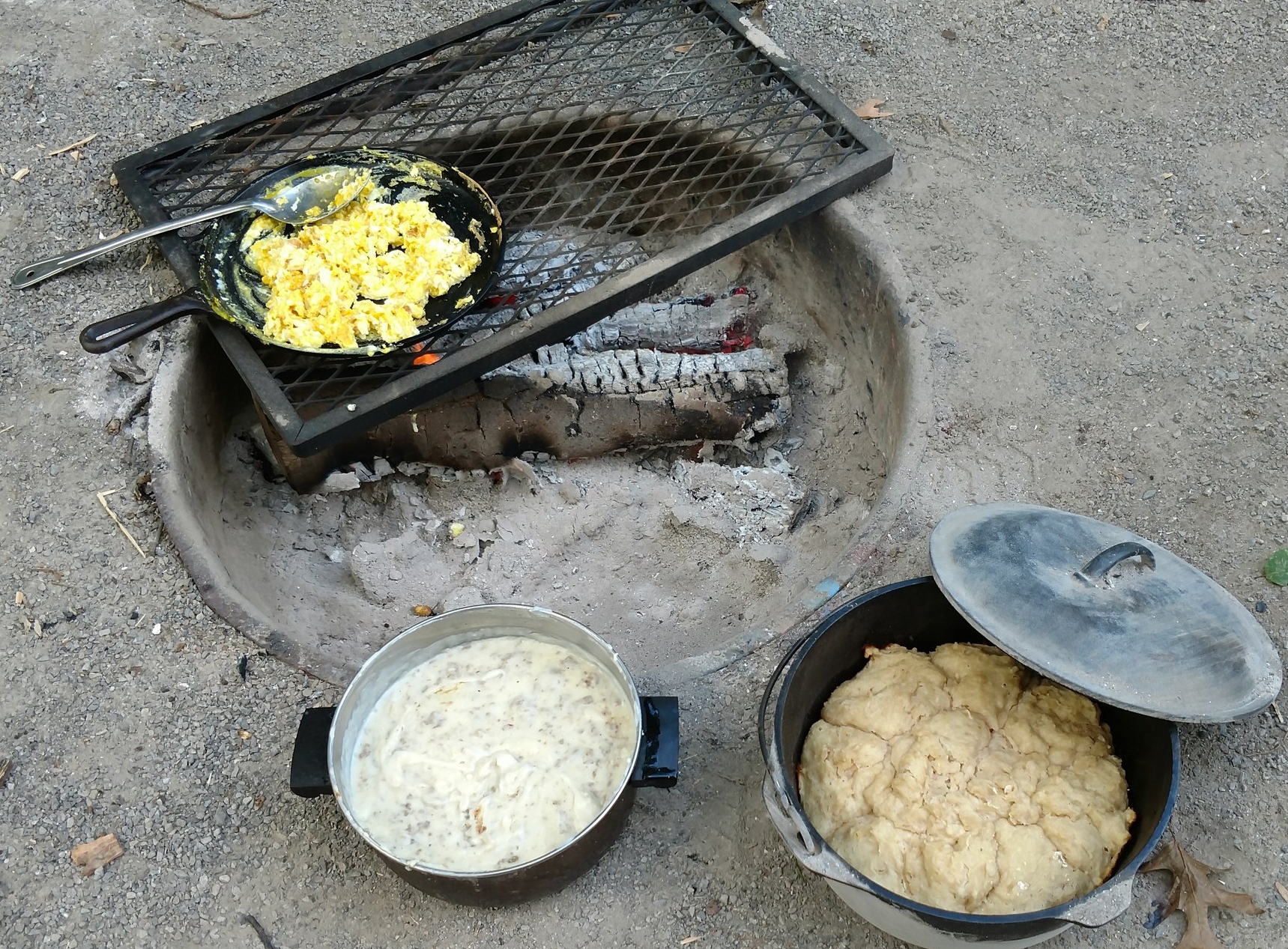
Breakfast is a special meal for us – well I can’t always get together a traditional meal before sending everyone off to work and school, but when I have the chance I usually take it (not always in morning hours either!) and my husband particularly wants a big country breakfast when we’re camping.  Biscuits, eggs and sausage gravy served with homemade jam and eaten with friends is a great way to start a day.

It reminds me of stories of men “baching-it” when work took them away from home.  One bunch were renting a room when the landlady raised the prices.  Refusing to pay her price, they moved out under a bluff to fend for themselves.  Now they had the express purpose of working a job they couldn’t get close to home so I doubt they spent a great deal of time cooking elaborate meals.  But at the same time I also doubt they had many boxes of Cheerios or protein bars so this is the only kind of food they could have made.  If you do it every day you get a lot faster at it.

IMG_20180702_085257997.jpg

I also think of the American pioneers who traveled hundreds of miles on foot or wagon to settle our nation.  Those families were cooking out of doors for large and growing families.  Women stooped over fires like mine after walking behind a wagon for 10 hours or when 7 or 8 months pregnant.  I had all the time in the world to both prepare and clean up after this campfire breakfast.  I didn’t have another day on the trail before me and frankly I can hardly imagine facing that.

I’ve said this many times and I anticipate repeating it yet again – I thank God for the conveniences we enjoy today.  I am also thankful to remember the ones who went before us and the hardships they endured.  I look forward to teaching my children how to make a meal over an open fire while reminding them that this was at times a common occurrence for our ancestors.

New Kin and Old Paths


I met a new family member recently… Dale Welch was telling me about his great-great Grandparents who lived in the Martha Washington community.  He mentioned the grandmother’s maiden name was Elmore and that got my questions started.  Turns out she was a sister to MY great-great-great Grandmother!  We parted with a ‘good-bye cuz’ and a promise to get together soon to share information.  (I have much to learn from Mr. Welch’s wealth of historical information!)

You know that as soon as I could get settled in front of my computer with a decent internet connection I was probing for information about this branch of the family.  Well I still have work to do on it, but it led me to a census record from 1880 where I found Margaret Elmore Wilson living with her husband Joe in the 4th Civil District of Fentress County, Tennessee. 

1880 Census Wilsons.jpg

One fascinating thing the Census Records show is who was living around your ancestors and I love looking through these records and seeing familiar family names as well as families I’ve never heard of before.  While Bagwell, Nation and Whitehead aren’t families that I grew up around, several family names are still well represented in the Martha Washington community:  Ashburn, Neely, Wilson, and Miller. 

For years I’ve been recording genealogy of not just my ancestors, but also of every family that touched my own family tree.  Now I find this a fascinating endeavor because I have cataloged most families in Martha Washington and Camp Ground, then as members of the families chose spouses from off the mountain, the tree extends even further.  (So much for the jokes people make that mountain family trees have no branches – I’ve got news for them, we’ve got roots they can’t even keep up with!)

Joseph and Margaret Elmore Wilson were the people I started looking for.  Right before them are Berry and Julia Wilson with two children still at home:  Artemia and Laura, and a boarder living with them named Davis Ashburn.

I found a Davis Ashburn in my database who was the son of Robert Wesley and Hettie Smith Ashburn.  His age matches up with this boarder, and his father is living in Cumberland County at that time with five children still at home. 

As you so often hear me mention, this research left me with more questions than I started out with.  Turning the page to entries the census-taker made on June 18, 1880 the Emily Norris family is listed with her 6 children.  She is my paternal grandfather’s great grandmother and their family home was always in Roslin – so seeing her with her children in Clarkrange presents a real mystery.

Even with the new and unanswered questions, this is a fascinating glimpse of the neighborhood nearly 140 years ago.

Skirmish at Dug Hill

This week I had the distinct pleasure to chat a few minutes with Historian Dale Welch and he shared with me a booklet he’s put together and entitled Shadows of Gray.  It contains 12 articles about brave Confederates who hailed from the Cumberland Plateau.  Today I’d like to share one article with you about the only major skirmish fought in Putnam County.

Even with the blacktop and traffic, the Calfkiller Valley between Monterey and Sparta is more peaceful today than it was 150 years ago, on February 22, 1864.  A skirmish or battle took place that day in Putnam County, near the White County line.  While families who lived along the Calfkiller River were harassed, robbed and killed by both Union and Confederate forces, along with thieves and bushwhackers, what became known as the “Battle of Dug Hill” was the only major skirmish in Putnam County.  The modern Calfkiller Highway bypasses the site of the actual battle, but the story lives on.

Different Union commands would establish a base during the Civil War, at Sparta.  Sometimes, it would be Col. Garrett and other time Col. William B. Stokes.  During the winter of 1864, Col. Stokes and his 5th Tennessee Cavalry US, was in charge.  HE sent out word across the area that he was “raising the black flag,” giving the Rebels “no quarter” – meaning he would take no prisoners, but kill every last one of the bushwhackers.

Champ Ferguson and his men

Champ Ferguson and his men

Confederate forces roaming in the valley were not your “everyday” bushwhackers.  Some of them were regular officers and soldiers who had been cut off from their command, li8ke Confederate Colonel John M. Hughes, of the 25th Tennessee Infantry, Captain George Carter, of Co. A, 8th Tennessee Cavalry, Capt. W. Scott Bledsoe, of the 25th Tennessee Infantry, Captain Champ Ferguson and his Independent Scouts, along with several more, including several Texas Rangers, all about 40 or so men together.  They heard of Col. Stokes’ black flag and it was alright with them.  They would give “no quarter” back to the Yankees.

The Confederates had also heard that Col. Stokes had planned to send out a force from Sparta up the Kentucky Stock Road to Cookeville and come back through Dry Valley.  The Yankees were commanded by Captain E.W. Bass, who had been a resident of nearby Liberty before the war.  But, Col. Stokes was not with them.  He was giving a speech to the citizens of Sparta that day.  He liked giving speeches.  He had been a U.S. congressman before the war (and also, elected after the war) representing middle Tennessee districts.

Rebel forces began making plans of their own to meet the threat.  The rebel “bushwhackers” decided to meet the Yankee force along the road from Dry Valley through the Dug Hill.  There were large boulders, cedar and laurel trees through a stretch of road.

In the afternoon of Feb. 22, the Yankees headed through the Dry Valley, when they were startled by a shot that rang out.  They looked up and saw a couple of riders racing away.  Just as the Rebel “bushwhackers” had planned, the Yankees gave chase and were soon in the middle of an ambush.

As the volley rained down upon them, Yankees began tumbling off their saddles.  They scattered everywhere in the onslaught.  The Rebels were in pursuit on foot behind them down the road and up the mountain.

John P. Gatewood, an 18-year-old, who was six-feet tall, with long curly red hair, was a member of Champ Ferguson’s Scouts.  He had been a member of a regular Confederate unit, but the Fentress County native had returned to the area.  Gatewood, with pistols in both hands, chased 5 Yankees up the hill.  They surrendered when he ordered them to stop, because they didn’t think he was alone.  When they saw that it was just him, two of them broke away.  Gatewood began shooting them, when Capt. George Carter came running up and hollered, “Hold on, John! Don’t waste your ammunition, as we have to fight for what we get.”  Carter took stones and bashed the [remaining] three soldier’s heads, giving them “no quarter,” just as it had been threatened upon them.  Gatewood left his mentor, Champ Ferguson soon after the battle and formed his own company in south-east Tennessee. 

It was estimated that only one-third of the Yankee force escaped.  When Stokes’ wagons picked up their dead the next day, they recovered 41 bodies.  All had been shot in the head, except three.  Their heads had been bashed in with stones.  The recovered bodies were laid in an old store in Sparta and then buried.

Several Yankee soldiers made it back to Sparta the next day.  Capt. Bass made it back the next day bare headed.  He had lost his fine plumed hat in his escape.  Russell Gann made it back after he had hid in a hollow log all night until the coast was clear.  Some Yankees had pulled women’s dresses off of clothes lines along the way to disguise themselves.  Others were never recovered.  Some skeletons were found the next winter.  One Calfkiller resident said that a young rebel came up and asked for water and told him he had killed a Yankee up in the woods above the house.  The man checked the next day and found a body half-eaten by dogs.

A little while later, Yankee Col. Blackburn challenged Col. Hughes to meet him and 75 picked me in a fight in a field near Yankeetown.  The Rebels shows up, with around 50 men.  The battle wound up in hand-to-hand combat before the Yankees sounded retreat.

Before the war was over, in the spring of 1865, there were many more sorrows heaped upon the people of the Upper Cumberland.