Tennessee Mountain Stories

Clyde’s School Days


[There is just a little overlap from last week’s article here, but I wanted to include all of Clyde’s school memories together.]

Clyde Whittaker attended Monterey School from 1930 - 1943.

He writes:

We moved into town near Grandma Whittaker when I was five.  I started school at six.  All twelve grades were in one building.  No running water the first year.  We had a girl and boys outdoor toilets.  There was a well with a hand pump near the back entrance.  Each class had a water bucket.  In lower grades the teacher would send two boys to fill the bucket and carry it back to the room.  Each kid had a telescoping cup that collapsed until you could put it in your pocket.  Each room had a large pot-bellied stove for heat.  The teacher would send two boys to the basement to get a scuttle of coal.  The teacher had to keep the fire going. 

In second grade the teacher got us samples to pass to the kids.  She got a small tube of Vaseline for each student.  I put a small dab of Vaseline on my hair.  I punched the cute girl in front of me to look at my hair.  She said it looked good.  So I put the rest of the tube in my hair to make it look even better.

Each class had a picnic near the end of the school term.  The usual place was the woods near where I lived.  When we finished eating I told Mary Frances I knew where there was lots of wild flowers.  When we got back to the picnic area no one was there.  When we got back to the hill and could see the school the last of our class was going in.  One of the girls yelled that Mary Frances was in the woods with Clyde.  Mary Frances yelled back, “You just wish it was you.”

In the fourth grade the teacher wanted a demonstration of a debate.  Mary Francis and I were selected.   We sat together in a corner and worked up the debate.  We enjoyed the task.  Shortly after that her father, a Methodist pastor was moved to another church.  I thought that was a terrible thing for the church to do.

In the fourth grade I sat near the front of the room.  The teacher called a boy to the front.  He had been making trouble and she was going to paddle him.  In those days a teacher was judged partially on her willingness to use the paddle when necessary.  As she paddled him I looked up and saw tears running down her face.  She was doing what was expected of her but it was hurting her more than the boy.

In the fifth grade we had an old maid, Flossie, a wonderful teacher.  When she needed to leave the room for a short time she would say, “Clyde tell the class a story.”  I would stand and tell something I had read.  One time I made up a story to tell.  She called on me maybe five times during the year.  She never called on anyone else.  [That year] I entered a speech contest which was part of a regional school competition including athletic events.  I was on the stage well into my speech when three high school boys in the back of the auditorium started laughing loudly.  I thought I did something and started thinking what it was and mixed up my speech terribly.  I didn’t realize until much later, they didn’t’ even know I was making a speech, they were joking among themselves.

I was either in fourth or fifth grade when our neighbors the Way family was going to kill and butcher a hog.  I had never watched the butchering of a hog so I decided to play hooky from school and watch it.  I thought no one would notice but my Mom saw me playing around the neighbor’s house about a hundred yards away.  When my Dad got home he cut a limb off a peach tree near the back steps and used it to give me a good whipping.  I had other whippings but I remember that one best.  I deserved the whipping and it hurt.  To my parents, school was serious business.  In those days parents who didn’t give their children proper guidance were considered neglectful.  I know now that whipping me caused my Dad more pain than it did to me.  [Someone asked me], “Didn’t you hate your Dad for that?”  I said no that I deserved everyone I got and deserved some I didn’t get.  We didn’t have much in those days, but I knew my parents always did the best they could under the circumstances that existed at the time.  I never had any doubt that my parents loved me and I loved them.

In most ways sixth grade was an uneventful period.  I have told people that from the age of twelve I bought most of my clothes – not all but most.  Mom made my shirts until I joined the Navy.  I was given a shirt, store bought, at least once maybe twice.

In the sixth grade I didn’t own a book.  In those days our students had to buy their own books.  I had a little money but I used it to buy overalls and shoes.  I would go in thirty minutes or more before class started and study using my friend’s book, which was left in their desks overnight.  At lunch I would rush two blocks home and eat a little lunch and rush back to school to study another thirty minutes before class started.  One day we had a test I don’t remember the subject.  The teacher was chewing out the class.  Everyone had done very poorly on the test except Clyde.  He went on to say Clyde don’t own a single book.  I was so embarrassed that I never told anyone until about three years ago I told [my sister] June.  I had come to realize that he didn’t mean to insult me but was complimenting me for doing well on a test under difficult circumstances.


Early Life in Tennessee as recounted by Clyde Whittaker

[Clyde was born in Monterey, Tennessee in 1924.  His mother was 19 years old and he was her first child.  Clyde’s father was native to the Monterey area but his mother’s family lived in Martha Washington.  His sister June would be born 22 months later then a brother the following year. There were a total of 5 children.]

Clyde writes:

I am interested in sharing how different life was for me and my family from life today.  My earliest days I lived about half a mile down the road from Steve Welch’s house.  We rented a small house with two rooms in front, a porch across the front and a narrow room across the back which we didn’t use except in bad weather [when] Mom did the laundry there.  There was two beds and a pot-bellied stove in one.  The other room had a table and chairs and a small cast iron cook stove.  The stove was called a step stove because the two caps over the fire box was about three inches lower than the part over the oven which had a door on both sides.   It was so small that Dad made a platform to raise it about a foot to make it a good height for Mom to work.  It was a wood stove.  We burned coal in the pot-bellied heater. 

In those days if you bought or rented the usual small house there was not cabinets or appliances.  Usually not even a closet.  There was no running water, electricity or phone.  Most people didn’t have enough clothes to need a closet.  For water we had a well in the back yard.  A narrow bucket was lowered on a rope then a crank was turned to raise the bucket.  Wells in the area were usually 30 to 40 feet deep.  The water had a yellow iron oxide in it that would stain laundry so we had a large wood barrel at a back corner of the house to catch rainwater for laundry.  We called it the rain barrel.

I remember June and I looking through the fence near the road to watch people passing.  Cattle ran loose that time so you had to have your yard fenced.  There was only one or two cars passing per day but there would be wagons pulled by horses or mules.  It was a dirt road that was graded by horse drawn scraper two times a year.  Some rode horses to town.  One morning we saw a dead cow by the railroad track.  The railroad paid for cows it killed.  An uncle said, “When a cow is killed it suddenly become a $100 cow.”  A good cow at the time was $25 or $35.

We didn’t have many toys so we played with what we had.  We had two one gallon buckets.  We put a short piece of lumber on the two buckets and that was our car.  I used a bucket lid for steering the wheel.  No women we knew drove.

I had a little dog named Jyp.  My great Uncle Frank shot him because he chased his hogs.  It was a very small dog and couldn’t hurt the hogs.

I usually wore bib overalls and a blue shirt made by Mom and no underwear except in winter when I wore long Johns.  I took off my overalls and slept in my shirt.  I had at least two pairs of knickers in my young years but didn’t like them.

We didn’t have mattresses at that time.  We had a tick filled with wheat straw which sold in bales like hay.  The bed springs was an open array of springs not in a box.  I had no trouble sleeping on it.

One day a farmer with his mule drawn wagon stopped in front of the house.  The farmer asked Mom if she wanted to buy some mutton.  Then there was no refrigeration so if a farmer killed a cow or sheep except in freezing weather they had to sell the meat they didn’t want.  They put a sheet in the wagon with the meat on it then covered it.  He would go house to house in town until he sold the meat.  Mom told the farmer no.  I didn’t know anything about mutton but I told Mom she should buy some.  She called the farmer back and bought some.  To this day I remember how the cooking mutton smelled.  We probably threw it away.

All of this may sound like we lived in poverty, but we ate well and had good clothes.  Most working men lived in small houses that the poorest today wouldn’t live in.

Dad bought Mom a new sewing machine in 1928 for $75 which was a lot of money then.  Mom made many shirts and dresses over the years.  We moved into town near Grandma Whittaker when I was five.  I started school at six.  All twelve grades were in one building.  [There was] no running water the first year.  We had a girl and boys outdoor toilets.  There was a well with a hand pump near the back entrance.  Each class had a water bucket.  In lower grades the teacher would send two boys to fill the bucket and carry it back to the room.  Each kid had a telescoping cup that collapsed until you could put it in your pocket.  Each room had a large pot-bellied stove for heat.  The teacher would send two boys to the basement to get a scuttle of coal.  The teacher had to keep the fire going.  The following year we had running water, steam heat and indoor toilets.  In first grade a new girl joined the class, Mary Frances, wearing a red polka dot dress with bloomers of the same material that were three inches below the dress.  I thought she was the cutest girl I had seen.


From Dirt Roads to Space

The mountain has so many traditions, cultural nuances and memories to research and record that I rarely focus on a single individual.  However, there are a few that cross my mental pathways that beg to be shared.  Today I want to introduce you to Clyde Whittaker.

Now Clyde is my first cousin once removed on my father’s side.  He is the oldest grandson of Billie and Ida Key; my father is more like grandchild number ten of thirty-three.   The beauty of a close-knit extended family is that you know a whole lot of uncles and aunts and cousins.  The sadness of knowing all that family is the difficulty of keeping up with all of them.  But Clyde has done me the very great honor of not only telling me some of his stories but actually writing them down and permitting me to share his life with you through these stories.

Clyde will turn 93 this month - this may take more than one article. Over the next few weeks I’ll share some of Clyde’s stories in his own words.  Today I’ll give you a bit of a summary of his life.

Clyde was born in 1924 in Monterey, Tennessee.  There he would grow up while his father worked for the Tennessee Central Railroad and his mother raised five children.  They had very little, they were not alone in their poverty in that day but neither did they wallow in it.  They worked.  The whole family worked.  And as I share with you some of Clyde’s achievements the resounding theme is work.  It’s what I hear when I talk to him, “Well I worked hard.”  He never asserts he was the smartest guy around, although he surely is very intelligent.  And no one would claim he had more advantages than others – if you think that please fast forward to the story about him sharing textbooks because his family could not afford them. 

I asked Clyde if his parents – who never enjoyed advanced education – pushed their children in school.  He simply answered that he was expected to finish.  Not finish in first place but just to finish.

And he did finish.  At a time when most young men would do well to finish 8 years of school, Clyde graduated from Monterey High School.  After serving in the Navy during World War II he put the GI bill to good use and completed a Bachelor’s degree in Physics at Tennessee Polytechnical University – that’s what they called Tennessee Tech in the 1940’s. 

Clyde and Ellen Whittaker.jpg

He married a local girl, Ellen Bilbrey, and together they went to Florida where he would get his Master’s Degree in Physics.

Keeping his eye on a bigger goal, Clyde turned down a job that would have paid him more that the Dean of the Physics department earned.  The family continued in Florida where Clyde worked in research.  In 1956 he was named in the “Who’s Who in Scientists in America”.  That’s already a leap from humble Monterey beginnings but he didn’t stop there.

In 1962 he moved his family to Houston, Texas to the Center for Manned Space Flight.  I haven’t asked Clyde how many people were there when he arrived but the announcement that the center would be in Houston had only been made a few months earlier in September 1961.  

Clyde worked with the men who would walk on the moon.  He met with German scientists recruited to America following the fall of Nazi Germany.  He was among those pioneers that opened the space frontier.  Yet his roots run right back to Monterey, Tennessee.


Lamp Collection

I have collections – completely by accident mind you.  I never go out and think, “I collect this so I should buy it”.  Somehow these collections just happen at my house.  And I love them.

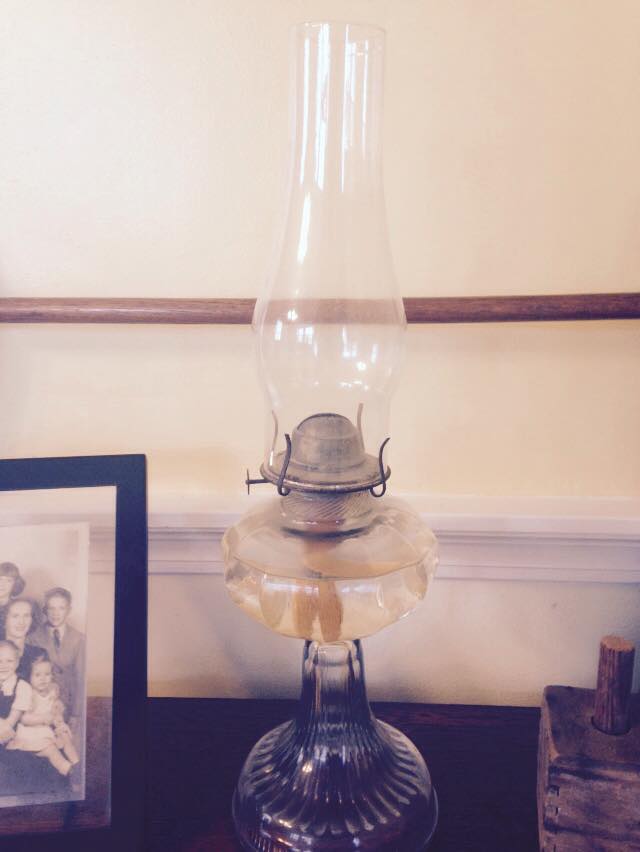
Well last week’s article was accompanied by a photo of a coal oil lamp that I don’t even own.  My Aunt Roberta had it nicely displayed in her kitchen and I snapped the picture just for the blog.  However, the responses I received on Facebook made me think about all of the lamps that I’ve collected and I wanted to share some of them with you.

It goes without saying that in the pre-electric homes of our grandparents coal oil lamps were indispensable.  Yet they were precious and therefore protected and that means they’ve been handed down.  If you’ve inherited one of these treasures, did you ever think about how much it must have meant to the people who had it before?  They touched it every day – or else they went to bed with the sun and didn’t rise until good daylight.  It had to be cleaned and filled regularly and would have set near the center of the home – for no one wastes their only light on a corner.  One reader mentioned that she “got her lessons” by this type of lamp, and many children would have spent time hunched over tablets or slates near the lamp. 

Now if this was my principle means of light I imagine I’d find a few minutes during the daytime to do my needlework despite the quaint picture Hollywood paints of women sewing by lamplight.  However, I know there’s been many pages from The Good Book read by coal oil light for daylight hours are valuable and the quiet family time of an evening are ideal for studying The Bible.

Even understanding how much it would be used and how important the lamp was to the home, there was not a lot of money to be spent on them.  Therefore as with most products, there were models offered at varying prices.  I tried to do some research to learn what I might about these models I’ve inherited and was amazed how difficult that was. 

I did learn that oil lamps were produced all the way through the depression years.  It was after World War II that electrical power really reached to the rural areas therefore there would have been demand for new lamps until then.  In fact, there were improvements being made to lamps well into the 20th century.  The Aladdin Lamps which offered incredibly bright light for their day were first sold in America in 1909.  The burners were imported from Germany where the technology for a center draft burner had been developed just three years earlier.  And of course fuels were always evolving from the olive oil used in biblical times to the refined kerosene that we can still buy as “lamp oil”.

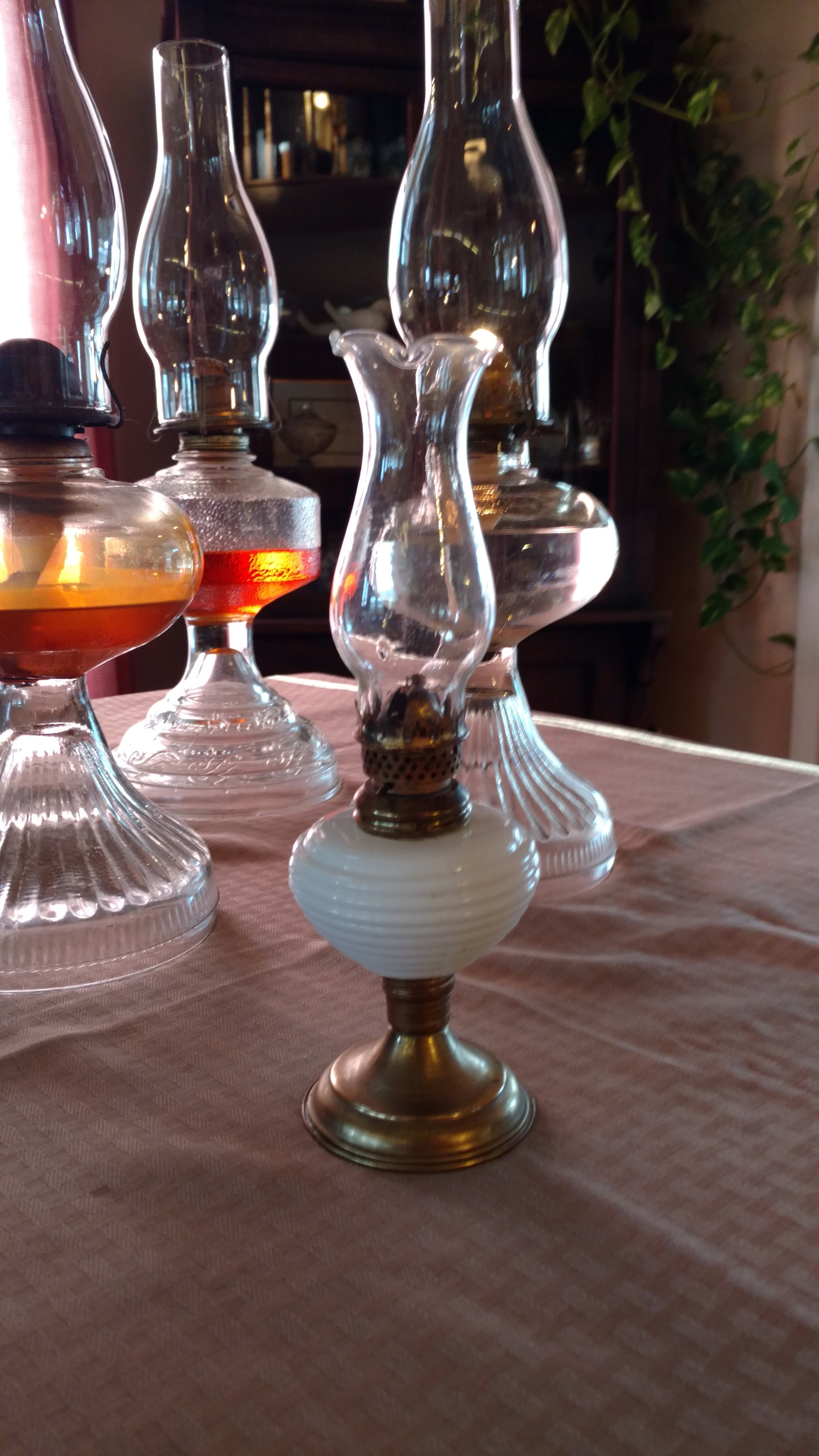
Reader Rose Davis had this lamp with a fluted fount (the part where the oil is held). 

Reader Rose Davis had this lamp with a fluted fount (the part where the oil is held). 

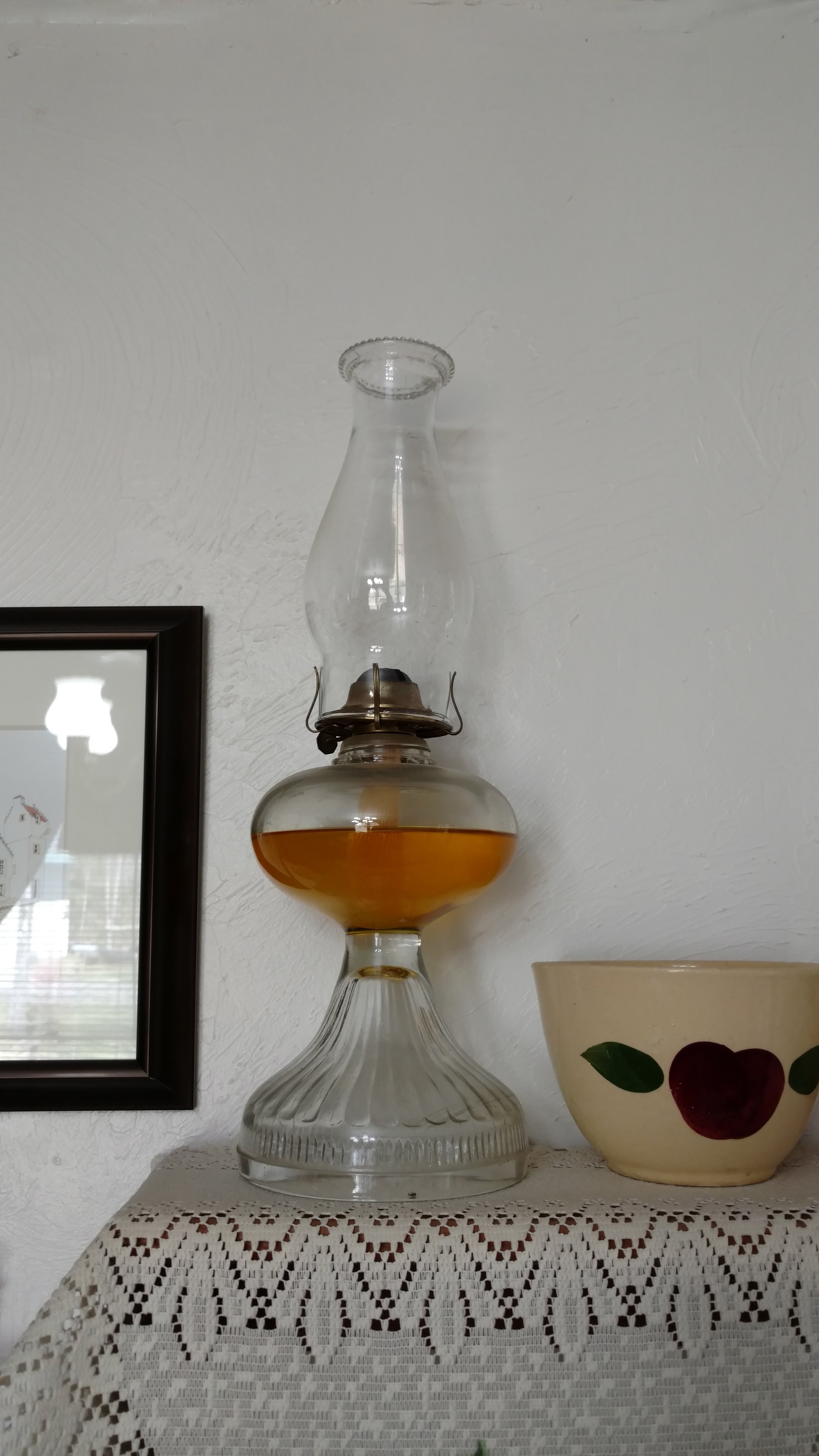
Several folks said they have lamps just like the one pictured in last week’s article.  I’ve seen a LOT of these on the mountain and I imagine it was an economy model.  In fact, I have a pair of lamps with a beautiful scroll pattern around the foot of the lamp and I found the same model for sale at www.oillampantiques.com for about $84.  The site mentioned that it dates from the early to mid-twentieth century.  So that answers one of my questions – I’m always curious to know how old some of these lamps are. 

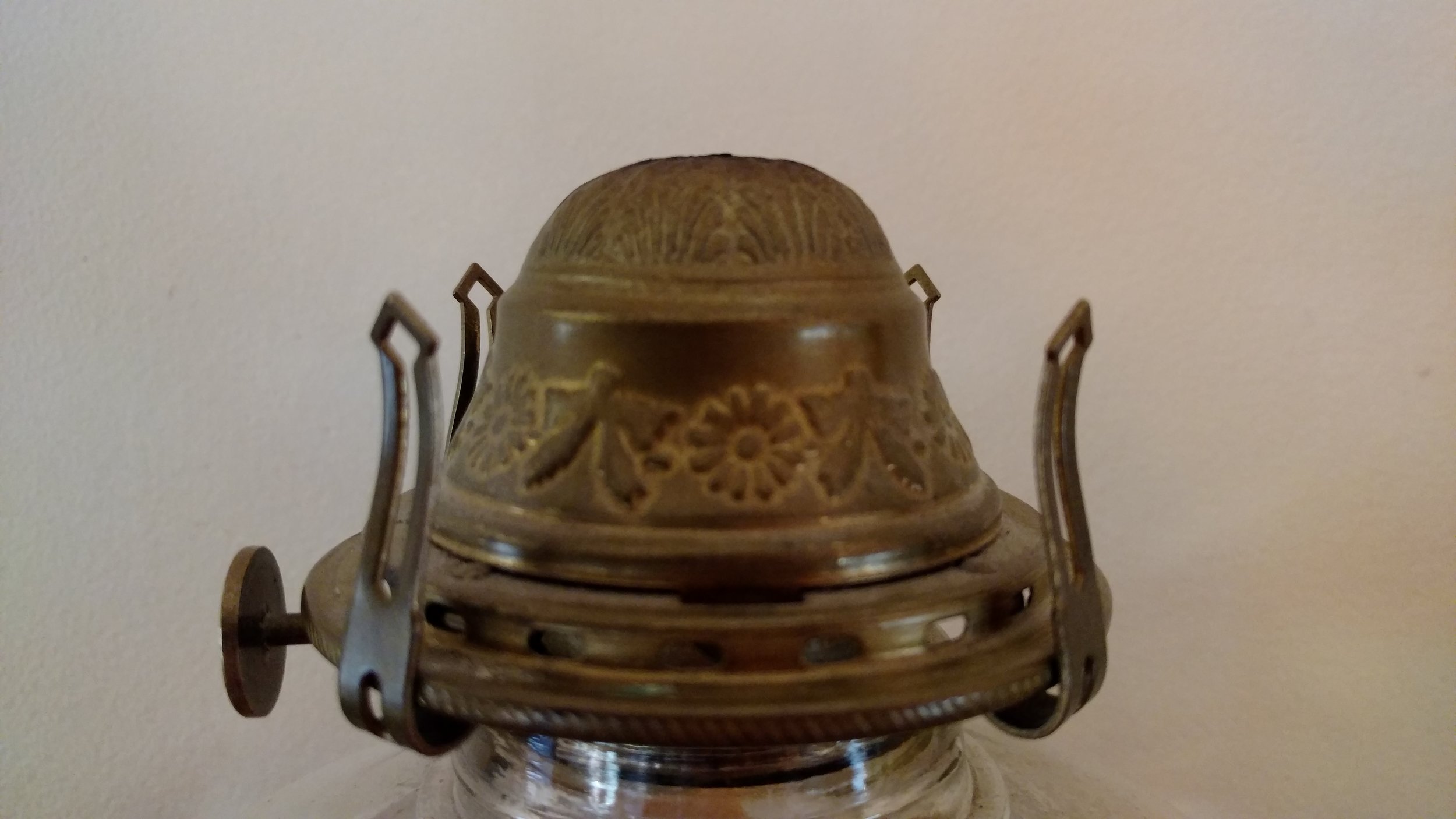
Replacement Burner - Isn't that pretty?  I wonder if original burners were ever decorated like this?

Replacement Burner - Isn't that pretty?  I wonder if original burners were ever decorated like this?

All of my old lamps have flat wicks – although I recognize they may not still have their original burners because that part of the lamp seems to wear out.  In fact, I've replaced a few burners and I'm thrilled replacement parts can still be found pretty easily for my lamps.  I have new lamp that has a round wick – or rather a flat wick in a circular burner.  This is similar to the Aladdin lamps but those have the addition of a mantel that glows when heated and produces significantly more light.  The center-draft wick is supposed to put out 3-4 times more light than a flat wick.

A repairman came into my home one time and commented on my lamp “collection” – that was probably my first realization that I was collecting them.  It turned out he was an avid collector of antique lights and had a lot of information about their ages and origins.  Maybe one of you have similar information – I’d sure welcome your comments!

This lamp may have no monetary value but it's one of my most prized.  It belonged to my Great Grandma Key.  I don't know that it's ever been burned.

This lamp may have no monetary value but it's one of my most prized.  It belonged to my Great Grandma Key.  I don't know that it's ever been burned.


By the Light of the Coal Oil Lamp

This is probably the most entertained I’ve been writing any of these blog articles.  I am writing to you tonight by the light of a coal oil lamp.  Well, that and my backlit computer screen – see the humor?

The power went out about 3 ½ hours ago and I’m sure the very-efficient electric guys will have it on before bedtime – at least I’m hoping so.  Still, it got pretty dark in the house and it seemed prudent to light some lamps to keep from bumping into stuff.  And you know me, it got me to thinking…

My grandmother has always been an avid reader and she’s told many times about her childhood and wanting to sit up late into the night to finish a book.  Her father would holler up the stairs, “Put that light out you’re a’wastin’ coal oil.”  And in fact, I’m sure coal oil was a very valuable commodity.  It was one of those things that a subsistence, mountain farm could not produce for itself.  Cash money would be required and as we’ve discussed many times, cash was always scarce on the mountain. 

Now I still find myself referring to these old lamps as “coal oil lamps” but in fact coal oil hasn’t been readily available in the US since the middle of the 19th century when large deposits of petroleumshifted distilleries to process kerosene. 

I tried to find prices of coal oil and kerosene through the years and found a Bulletin of the Bureau of Labor Statistics reporting Retail Prices 1890 to December 1913.   This showed the average workman’s household spent $8.15 per year on lighting.  I’m pretty sure that wasn’t an Appalachian farmer for those households spent $326.90 on food annually and there was scarcely a home on the mountain that saw more than $300 in a year – but there’s a whole different story to be had in that booklet.  I also wonder if that would have included some electricity since by the end of this period some homes in larger cities began to have electric lighting.  Other than that information, the world wide web is mum on this price despite reporting coal and heating gas prices. 

Still, we know from experience that those items that the farm couldn’t produce or nature didn’t provide were dear.  Of course, the resourceful farmer could find other options –beeswax candles or lard which will make a smoky lamp if necessary.  Don’t you remember the scene from Margaret Mitchell’s Gone With the Wind when Scarlett comes home to Tara and the room is lit by a wick suspended in fat held in a gourd? 

I often mention that while I revel in the stories of the good ole’ days there are sure things I enjoy about our modern way of life.  It’s not cold tonight so I’m not particularly worried about the absence of central heat.  And the power will certainly be on before I’m forced to wash clothes on a washboard (which I do own of course).  In fact, we ate a cold supper and did just fine with it so food isn’t even much of a concern (I’m not above building a fire and sticking an iron skillet on it).  But it doesn’t take long without electricity to realize how heavily reliant we are on it.  I have well water so we can’t even open the tap – but of course I’ve got some jugs on stand-by since I’ve been in this situation before.  The house is amazingly quiet without the hum of the fridge, dishwasher, radio or tv.  And children certainly find it hard to understand why their favorite programs cannot be had.

Still, it’s nice to look out and see the stars instead of the security light.  And the quiet is so peaceful.  We need to do this every once in a while both to appreciate the conveniences we take for granted as well as to appreciate the beauty of the world God gave us.