Tennessee Mountain Stories

A Delicious Failure

I’ve been thinking a lot about food lately – would it surprise you to know that it’s a result of trying to be more disciplined in my eating?  In talking with a friend about cakes and icings, I got to thinking about old fashioned boiled icing so I made this lovely cake.

Just take a moment to laugh, it’s fine, we all did.

Now I’m willing to admit – even photograph – my less than perfect creations.  I’m willing for two reasons.  First, I’m far from perfect and a product like this helps remind me.  Secondly, I always want to encourage people to try new-to-you recipes even if they don’t always turn out perfectly.

But it’s a third reason why I’m sharing this failure with you today.  I made this in my climate-controlled home on my easily adjustable electric stove and whipped the egg whites with my counter-top mixer.  Yet this is a very, very old recipe.  In fact, it was the standard cake icing for my grandmother’s generation.  However, they made this sweet treat with none of the conveniences I just listed. 

Can you even imagine cooking delicate foods like this icing or candy over a wood-fired stove?  No temperature control, just drag the pot farther from the fire box if it gets too hot.  And by the way, it’s a warm day today and standing over that old woodstove would have been hot everyday of the year.

Then there’s the question of beating egg whites.  How do you even accomplish that without a mixer?  Grandma had a hand beater – like the blades of the electric mixer but with a handle, gear and crank at the top.  I suppose if you didn’t have one of those you could beat a wire whisk hard enough and long enough to transform egg whites into meringue but it makes me tired to even think about it.

I’m sure it turned out runny sometimes in that generation too.  They ate it anyway – just like we did.

Now, I don’t own a candy thermometer- and maybe today’s fiasco is the reminder that will make me add that tool to my kitchen toolbox – but I can see my Grandma standing at the stove with a tablespoon held high above the pot, waiting for the syrup to “spin a thread”.  I had the hardest time learning what that meant and how you could ever see syrup in a thread.  Well, eventually she made me understand and I’ve been using her method ever since.  It really has worked in the past.

I learned so much in Grandma’s kitchen.  The fact is, there were lessons learned there that I didn’t realize until much later – maybe she’s still teaching me despite losing her nearly ten years ago.  Pulling out a recipe like this is a sweet reminder of Grandma and big family dinners at her house and the clan all gathering together to fellowship despite the quality of the food that was served.  (But didn’t the food seem better at those meals?)  Maybe that’s why they were able to make this beautiful icing with rudimentary tools – they knew it would be appreciated no matter how it looked.

Do you remember scratch cakes and boiled icing?  I’d love to hear about it.  Please click “Comments” below and if you have any trouble leaving a comment, you can click here for easy instructions.


Isoline Campbell namesake of Isoline, Tennessee

Isoline Campbell

Isoline Campbell

I am really excited about today’s article because the source is YOU – one of my readers.  Thank you Dee for sending me the information you found about R.O. Campbell and his daughter Isoline. 

Just as an aside, Dee’s email was particularly exciting because my vision for this blog would be a conversation among readers in the comments of the stories.  I have a little bit of information and knowledge – ya’ll have tons of it!  The trick is for us to all share it, and that’s how we can preserve this precious oral history.

Richard Orme Campbell was a wealthy Atlanta business man who started the Campbell Coal Company in 1884 (according to http://tomitronics.com/old_buildings/aunt%20fanny/index.html#isoline).  He built the business into the south’s largest coal company with mines in Tennessee and Kentucky.  We know that one of those mines was in North Cumberlad County. 

Orme’s oldest child was named Isoline, and the mine and surrounding community was surely named in her honor. It is interesting to note that Orme, Tennessee had already been established in Marion County, Tennessee where a mine had been established in 1892 and Mr. Campbell purchased it in 1902.

I never thought about the origin of the name Isoline but when I read it as a lady’s Christian name it was certainly new to me.  Turns out, the name is French in origin; an 1888 play portrayed a Princess Isoline.  The Orme family (R.O. Campbell’s maternal family) has some roots in France so Isoline may well have been the name of a beloved family member. 

Isoline Campbell grew up among Atlanta’s elite crowd and during her Grand Tour, she witnessed the German invasion of Brussels in 1914.  The experience changed her perspective on life, if not her very life. When she returned to Atlanta, she was more focused on service than society and she founded the Junior League of Atlanta.  This organization was purposed to, “[do] some good for the needy of Atlanta and [foster] among members interest in the community’s social, economic and educational conditions.”

One of the questions I posed last week was where the Cumberland Plateau Railroad was going when it ran from Isoline to Campbell Junction.  According to Duke’s Tennessee Coal Mining, Railroading, & Logging ({Paducah: Turner, 2003), Campbell built the Isoline spur line between 1900 and 1902.  The first trains arrived in Crossville in 1897 so the Tennessee Central line from Monterey to Crossville was already passing through the area that would become Campbell Junction.  So the Cumberland Plateau Railroad was connecting to that existing TC mainline.

Mr. Duke’s book also notes that Isoline had hotels, boarding houses, store and numerous businesses.  If any of you ever run upon any pictures of this booming Isoline, I’d love to see them for I had no idea it was anything like that thriving description.

There is no description of Campbell Junction and I’m still wondering whether that end of the spur line built up as much.  At least it had staying-power for there is still an operating post office at Campbell Junction and Isoline was long ago absorbed into Crossville’s postal community.

After 53 years in business, the Campbell Coal Company dissolved in 1962.  The mines at Isoline had played out by the mid-1920’s and the spur line tracks were pulled up in 1939.


UPDATE:  4/10/16

A reader graciously shared the following article from 1914 about Isoline Campbell - she and I thought you might enjoy it.

Railroad Ghost Town

Campbell Junction DepotFrom Tennessee Coal Mining, Railroading, & Logging (Duke, Turner Publishing, Paducah, KY 2003)

Campbell Junction Depot
From Tennessee Coal Mining, Railroading, & Logging (Duke, Turner Publishing, Paducah, KY 2003)

A little over a year ago I wrote a guest blog for AppalachianHistory.net on ghost towns.  I got to thinking about this subject again this week; I’ll try not to repeat that previous post since you can click over and read it on that site.  However, I’m very fascinated by the changing communities and wanted to mention it here.

If you’ve spent much time tramping around our woods, you will have happened upon groups of foundation rocks that tell you there was once several homes in an area.  Or, maybe your family stories include tales from Key Town or Hood Town but Google Maps gives you no indication where they may be located.  These are the ghost towns I’m referring to.

We think of ghost towns out West where you can drive through and visit clusters of empty buildings abandoned when the gold or silver mine played out.  If you drive through our familiar mining town of Wilder you won’t see many old buildings.  I guess that’s thanks to our much more humid climate that quickly weakens abandoned buildings.  I understand that in the arid west you can leave houses or wooden wagons and such sitting outside for years without much noticeable deterioration.

I’ve mentioned that I’m preparing to speak to a fund raiser for the Monterey Depot Museum and it is that railroad research that brought Isoline to mind.  In reading a timeline of the Tennessee Central Railroad, I learned that in 1901 the TC purchased the Cumberland Plateau Railroad which ran from Campbell Junction to Isoline.  Now I knew that Isoline had been a busy spot in the early years of the twentieth century.  A big logging operation and a coal mine drew people to the area. 

There was a post office in Isoline from 1901 until 1935. Yet today, driving north out of Crossville on Highway 127, only the Isoline Baptist Church will tell you when you’ve entered the community.  As the state exercises its power of eminent domain and moves out houses in preparation for the widened highway, I wonder if even that little church will survive to remind us of this once thriving community.

An internet search for Isoline returns almost nothing.  There was one entry from roadsidethoughts.com that actually asked for input.  I sent them what I know which you can see is precious little.

If the TC bought the spur line in 1901, I wonder where that line was going prior to the the Monterey – Crossville – Emery Gap line that the TC built. 

Campbell Junction is a new community name for me, but I did find it on Google Maps in the Mayland area.  I know that whole area was big log country but I’m not sure what would join up just there to create the junction.  Yet this community still has had their own post office since 1858.

There are lots of factors that change where people live, work and do business.  Roads are a big factor as we’ve seen since the interstate highways were built almost sixty years ago.  It’s both charming and heartbreaking to drive down the state highways and see the old motels and stores which used to cater to travelers that are now routed far from the small towns.  Monterey is another great example; the railroad brought great industry to the town but without it, the commercial center of the county has shifted down the mountain to Cookeville.  I suppose there's a good possibility that both Isoline and Campbell Junction are similar victims.  When their logs and coal played out there was little to keep the population centered there.  We’ve certainly seen the same thing happen in the “rust belt” where population surged for automotive jobs and as those jobs moved overseas the people and their money also left.

There is certainly history in these two communities and I long to know it.  As so often seems to happen, I’m left with more questions than answers on this subject.  I love to write about these mysteries because I’m always hoping one of you readers will have information that you’re willing to share.  If you know more about Isoline, please be sure to click comments below and tell me what you know.


Chocolate Gravy and Other Comfort Foods

As I continue preparing to speak to the Monterey Depot Museum on April ninth, I was thrilled to read chef Bruce Wilson’s description of the dessert he’s planning:

“…my personal favorite course for this dinner is my signature dessert that combines my love of sundaes with my favorite childhood breakfast of chocolate gravy and biscuits! The freshly made whipped cream melts with the ice cream into the chocolate sauce and soaks into the sour cream pound cake and replicates the texture of that breakfast dish that we've all had growing up in this region”

And you know, that got me thinking…

Chocolate gravy was a favorite of my childhood too.  And I learned to make it at the feet of my Grandma Golda Stepp and I’ve continued to make it for the whole family.  In fact, we love to have family breakfasts – any time of the day – and hot biscuits and chocolate gravy are a staple of those meals.  Yet, outside of my family, I’ve found lots of people who’ve never enjoyed this delicacy.  In fact, an awful lot of people can’t quite imagine a combination of chocolate and gravy.  Still others don’t quite think chocolate for breakfast is proper.

But if you’re raised on it, this is the most normal thing in the world.  Of course, we think that of any foods from our childhood, don’t we?  I also ate “coffee and bread”, also known as “soaky” which is simply biscuits soaked in coffee with a little sugar on it.  I suppose that’s the ultimate comfort food for me – it’s certainly what I eat when I’m really stressed. 

All Gone!

All Gone!

I’ve seen an interpretation of some of my childhood foods in restaurants, especially in the South.  Apple dumplings are a popular restaurant food but I’ve never seen anyone make them like my Grandma and they’re never as good as hers.  Apple stack cake is rarely presented in public eateries, probably because you can’t quite make it pretty yet it’s an utterly Appalachian treat, as are blackberry dumplings.

I’m eager to see Chef Wilson’s adaptation of chocolate gravy and biscuits!

I’ve never really discovered the origin of chocolate gravy.  So maybe y’uns can help me with this one, because I’m thrilled to have readers who hale from all over the place.  How many of you have ever eaten Chocolate Gravy?  And was it from your childhood or something you were blessed with later on in life?  Just click “comments” below – if you have any trouble leaving your comment, click here for simple instructions.

Trains and Riding the Rails

Trains are a favorite subject of mine – there is a romance about the idea of rail travel that draws boys and girls of all ages.  The day of the railroad was a slower, sweeter time – at least in my imagination!  Imagine then my joy when the Monterey Depot Museum invited me to speak at an upcoming fund raiser.  I have all kinds of ideas bumping around in my busy brain as I try to organize this presentation.  More importantly, I am immersing myself in rail-research.  So I thought I’d share some with you.

I found a great little book entitled Railroading in Putnam County by Cookeville Depot Museum (2003) from which this article originates.

Cookeville, TN looking down Broad Street prior to the arrival of the Tennessee Central

Cookeville, TN looking down Broad Street prior to the arrival of the Tennessee Central

For years, local residents knew that the Upper Cumberland held a wealth of natural resources.  However, without roads or mechanized means of traveling on them, and with no railroad any cash crop had to make it to a major waterway.  From Monterey, Celina was thirty-five hard miles and the closest steamship dock.  That must have been utterly impossible for farmers of the mid-nineteenth century.  Therefore, most folks just raised what they needed and survived on what they raised. 

Then in 1893 the first trains began to make the long climb up the mountain to Monterey and almost magically opened the world’s markets to lumber and coal as well as livestock.  The idea of an east-west railroad had been alive for more than half a century.  In 1866 an engineer first surveyed the region for the Tennessee and Pacific Railroad.  He saw the wealth of resources the region had to offer.  He also saw the steep grade and rough terrain that would have to be conquered.

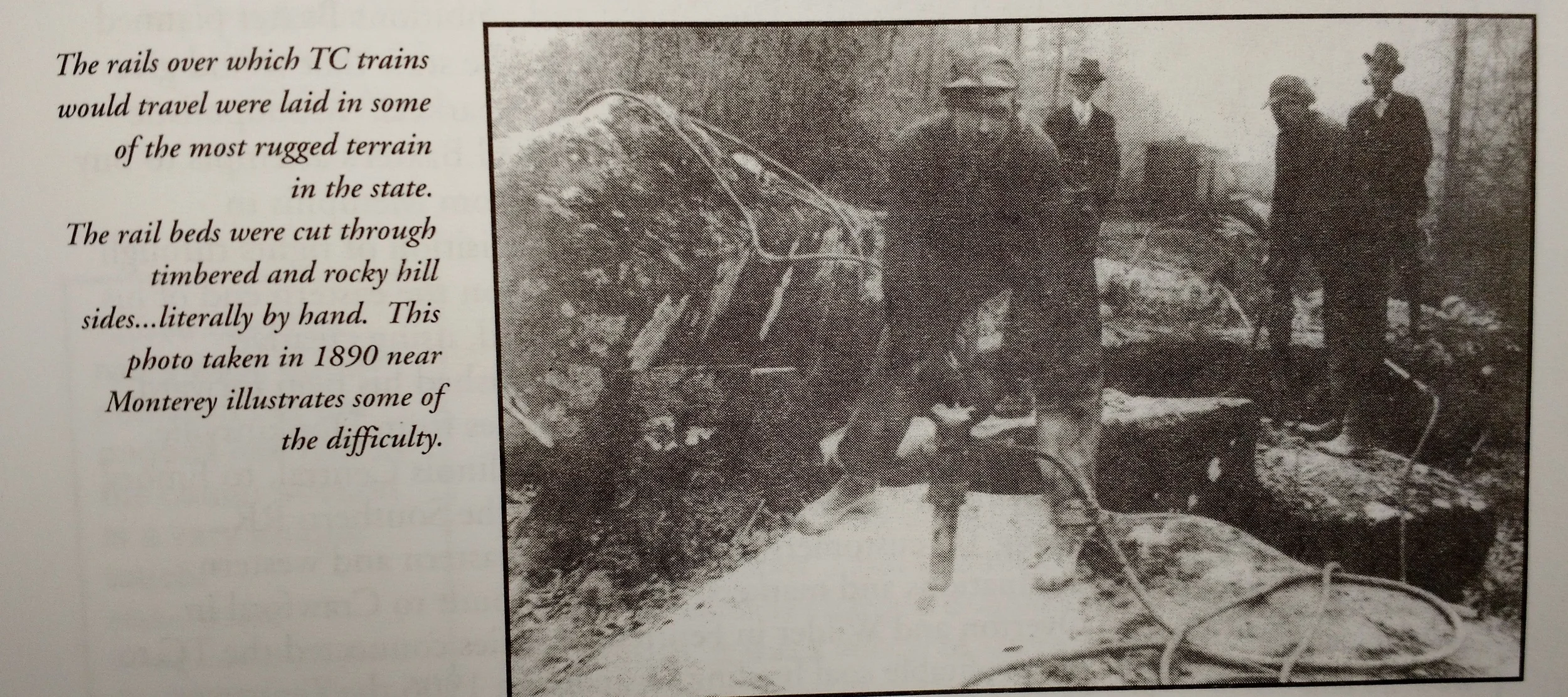
Those obstacles were overcome by sheer force of many hands.  Timber was cleared and rocks blasted to lay the tracks first from Nashville to Cookeville, then on to Algood and Monterey. 

Key to the rail project finally moving forward was the purchase of mineral rights to thousands of acres of Fentress, Overton and Putnam counties where coal beds would be harvested for the nation’s persistent energy needs.  Thousands upon thousands of loaded coal cars would leave the tri-county area over the next seventy-five years.  In fact, it was originally the Crawford family who both bought the mineral rights and funded the laying of the first tracks.  Jerre Baxter didn’t purchase the Nashville and Knoxville Railroad until 1893.

However, Mr. Baxter is the one we remember as the force behind what would become the Tennessee Central Railroad.  He envisioned a railline from Memphis across the state.  He was blocked by other railroads that didn’t want the competition and they were powerful.  They kept him out of Nashville proper, forcing him to bypass the city.  He turned his attention to the eastern side of the rail but was never able to reach beyond Rockwood. 

Still, to the people of Monterey, the TC was a blessing.  Directly employed by the railroad, were numerous locals who cleaned and repaired locomotives, laid and maintained track and worked daily loading both frieght and passengers.  The whole world must have seemed open to locals who could now ride “the Shopper” to Nashville for the day and be home by nine to sleep in their own beds.  By the early 1900’s there were six passenger trains passing through Putnam County each day.  You could ride the long distance to Nashville, or you could hop off at any of the communities along the way. 

Prices seem low to us today, one resident told of riding from Monterey to Ozone in the late 1930’s for thirty-five cents.  Of course, he was earning ten cents per day at the miscellaneous work a school boy could pick up.  Still, that thirty-five mile jaunt would have been impossible without the railroad.

The Tennessee Central called itself “The Road of Personal Service” and every member took that motto to heart.  From the flagman who would help you step out of the tall car to the brakeman who hopped between the cars to manually apply brakes as the train made the descent from Monterey to Algood, everyone along the route seemed eager to serve their customers.  No doubt they were happy to have the railroad and the many, many opportunities it provided them.

These were boon days for the Upper Cumberland region.  Jobs were available for local folks and were drawing in slews of outsiders as miners, railroaders, loggers and all of the services those cash-yielding jobs require.  The Tennessee Central would continue to haul freight through the region until 1967.