Tennessee Mountain Stories

Uncle Jack's House


Pictur of Jack Atkinson From his Son Luther’s book

Pictur of Jack Atkinson From his Son Luther’s book

As we continue our stroll through Key Town, the next stop after leaving John Mitchell Key’s house is Jack Atkinson’s.  He was widely known as Uncle Jack and is remembered as one of the finest men to ever draw breath. 

Louis Jackson Atkinson was born in 1883, his parents died when he was very young and his mother’s sister mainly raised him after that.  In 1905, he married Armintie Druzilla Key and settled in Key Town. On the 1910 census, Jack and Mintie have 2 children and they are living with quite the extended family – Mintie’s parents and grandfather (William and Mahala Key and Grandpa Stephen Key) as well as Jack’s sister Lou Cinda.
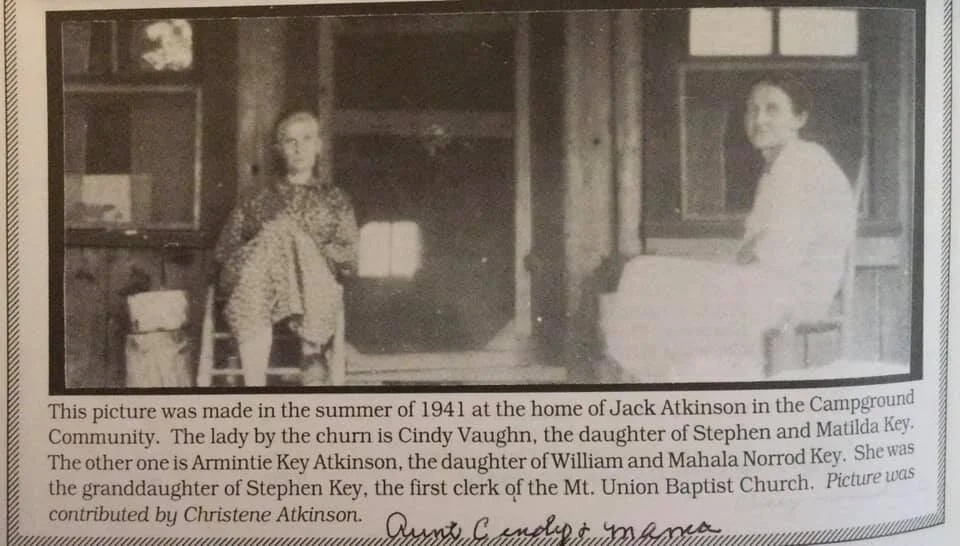
Lou Cinda Atkinson and Mintie Key.jpg

Mintie was the youngest of William Key’s 5 children so I can’t help but wonder if she and Jack were actually living in her father’s house.  However, Jack is shown as the head of that household, so I’m not sure – and there is another homeplace in Key Town that may have been William and Mahala’s.  We’ll talk about that later on.

Mintie (the “t” is silent in our vernacular, by the way) undoubtedly spent the vast majority of her whole life in Key Town.  Her father’s family came there when he was just 10 years old.  I don’t really know how she and Jack became acquainted, or exactly why they chose to make their home so close to her family but I know they were a blessing to the Keys. 

Stephen Key would pass away in the same year he was counted living with Jack and Mintie.  Whatever circumstances had William and Mahala in their daughter’s home, by 1920 they were counted in their own home, albeit right next door.  By 1925 William has passed away and Mahala again lives with her youngest daughter.

There are many, many stories from this home in Key Town because their son Luther dedicated a great deal of his life to cataloging pictures of area families.  Furthermore, their hospitality allowed neighbors in their home so even more stories survived. 

Jack was a kind man and yearned to cultivate kindness in his children.  One daughter remembered that every night they were asked to say something good about a neighbor.  Sadly, the family experienced much suffering.  Grandma Mahala fell and broke her hip leaving her bedfast for the last years of her life.  They cared for her despite the hard work required of a mountain farm family.  The whole family would go to hoe corn, leaving one young girl to look after her grandmother.  Several of the children taught school and daughter Frona contracted Tuberculosis – many people believed the infection came from the school.  Mintie cared for her daughter while her ailing mother still lived in her home, until the disease claimed Frona’s life at just 24 years of age.  The highly contagious – and at that time, little-understood disease – had invaded Mintie’s lungs; she would live with it six years and survive her mother by less than 2 years before she succumbed.

All four of the Atkinson sons served in World War II, and while none were taken by Japanese bullets, the youngest would die from TB in a Kentucky Veteran’s hospital just 3 years after Japan surrendered.

Yet the resilient family continued on.  Jack would eventually leave Key Town, after the children were gone to their own homes and families and the county road moved far enough East to make the community inconveniently remote.  That home-place was visited and re-visited right up till new owners, chainsaws and bulldozers have made it nearly unrecognizable and still we call it the Uncle Jack Atkinson place.


Key Town Beginnings

John Mitchell and Lottie Key.jpg

A few years ago I trekked into the forest with my Daddy and a couple of cousins to see the homeplace of my Great-great-great Grandfather, Stephen Key.  He was the founder of the now-abandoned Key Town.  Now, I don’t think he had any idea of starting a “town” – likely he had little thought of what the place would look like a century and a half later. 

I shared my thoughts on that trip here and wondered at the time why he would’ve ever settled in such a remote place.  I still don’t have the answer.  But his oldest son William would have been around 10 years old when he came to Fentress County and William stayed the rest of his life.  I don’t know just where William’s home place was, but I know where two of his five children raised their families right there in Key Town.

John Mitchell Key was a slight man, as many of the Keys have always been.  He wore overalls all the time and walked fast – I’ve heard it explained that they walk like there’s fire on their heels. 

He married Lottie Young about 1898 and built a two room home in Key Town.  It had a bedroom on one end and a second room on the opposite end that served as living room and probably kitchen.  A kitchen was added along the back of the house at some future time,  the addition revealed by the step-down required to enter that part of the house.  Lottie loved flowers and surrounded her home with Holly Hocks, Dahlias and roses.  There was only a small patch of grass and everything else was covered in flowers.

Her family remembers she wasn’t much of a cook but kept her family nourished and worked hard drying apples and making jelly from their peels.  She and John Mitchell raised sorghum cane and made molasses which were stored in gallon jugs along the wall of the kitchen floor.  Lottie was never idle, piecing quilts as she rocked in the home’s only rocking chair.  John Mitchell sat nearby in a homemade straight chair which he propped back on two legs against the wall.

John Mitchell kept bees in gums along the edge of his yard and would rob them of their honey each fall.  He was a deacon at the Campground Church where he would walk with his family each week along the road that ran directly from Key Town to the church.  It was only ever a wagon road without pavement or gravels.  This road was independent of today’s Martha Washington Road.

John Mitchell and Lottie faced many of the same struggles their neighbors did.  They buried 3 of their children two sons who died in their very early 20’s and left behind young children of their own.  Their youngest son was the only one to settle really close to them and he partly raised his family right next door to them.  After Maynard’s children were in school, they moved away from Keytown to allow better access to the school bus.  Still, they were scarcely half a mile from his homeplace. 

After all of her children moved out of Key Town, Lottie was no longer very satisfied and urged John Mitchell to move out.  As was the custom of the day, as age caught up with the couple and their health declined, they stayed with first one child and then another until finally The Good Lord called them home in 1957 and 1958. 

Their nearest neighbor for many years had been Jack and Armintie Atkinson – Mintie was John Mitchell’s baby sister.  Next week I think we’ll visit them.

Our Changing World

I may have mentioned to you before that I’m not a big fan of change.  Yet, everywhere I look things change.  I took a little trip to Key Town and the amount of change in that old neighborhood really got me to thinking – and reading a little about change

Albert Einstein said, “The measure of intelligence is the ability to change,” which may say quite a lot about me!  2 Corinthians 5:17 says, “Therefore if any man be in Christ he is a new creature: old things are passed away; behold, all things are become new”.  That is certainly change I can welcome.

A couple of weeks ago, I wrote about the changes brought about by road builders.  And, I know I’ve mentioned before the old roads that are growing up in scrub brush and briars.  The trip through Key Town encompasses all of these.

As a child I rode my horse many, many times down the old Key Town Road.  Even then it was long-since abandoned and the houses had fallen down and rotted away.  Still, there was the remains of a fireplace, foundation rocks or returning flowers.  The road was still very clearly visible and mostly navigable – at least by my sure-footed horse. 

In the years that have passed, properties have sold and fences built.  The trees just keep growing and now little saplings seem more like towering timbers.  Goodness that makes me sound old!

The ever-present briars create an impenetrable barrier to once familiar paths.  Without the tromping hooves of cattle, the barrier thickens every year.  Still, the flowers that cheered a family persist.  Shards of a Mason jar testify to some woman’s efforts to feed her family through a cold winter.  The creek is the same and if you look very closely you can see the depression of a road cut deep by steel wagon wheels and countless feet. 

Our whole world seems obsessed with change right now and I’m going to continue to fight the good fight against a lot of that.  I’m going to keep telling the old stories and remembering these lost towns even as the briars and scrub brush reclaim them.  I can’t help but take note of some of the changes and maybe show you a glimmer of what used to be.

Almost 5 years ago I wrote about “Mountain Family”, and the family featured there was from Key Town.  I think I’ll spend the next couple of weeks telling you a little about the other families there.  Stay tuned…

Steps of Change

Steps of Change

20210615_193618.jpg

There’s a big change taking place on the mountain as the main North-South road, Highway 127, is being re-designed.  Now, I’m sure I’ve mentioned before that I’m not a fan of change; yet I realize that an historian’s mission is to document change.  The beginning of roadwork got me to thinking about the changes wrought with previous roads.

Many of the Plateau roads have been modified over the years, in fact in pre-pavement days when a road became impassable, it might just be moved.  I suppose when the mountain was more sparsely populated and no fences were erected to confine stock it was easy enough to take a different route.  Country roads were never really planned, they were just the by-product of many feet passing the same way.

Before World War 2 and the rise of the automobile, feet were the only means of travel – whether it was your own feet, or those lent by a horse or a mule. Roads curved to take the easier route around a big hill, swamp, or even a farmstead.  And homes were built along those roads which further established the routes.

Then cars came along and the little footpaths had to change.  It only took a decade for the Tennessee’s State Highway Commission to begin work on a couple of the main plateau roadways.  By the early 1950’s highway 127 was being flattened and straightened with great hills blasted and lands appropriated where engineers deemed the road was lay.

Sometimes this meant that the road now passed your back door instead of the front door.  And often it meant that a home built straight out from the road was now perched upon a hill.  My own home currently has a 7 foot drop to the road despite being nearly level when it was built over 50 years ago.

Even though the growing popularity of the automobile was the catalyst for the new roads, there was still an awful lot of foot traffic.  And I don’t suppose anyone could foresee the day when no one would walk anywhere.  So those homes left perched high above the new road were given steps down from their yard. 

20210615_194852.jpg

The Martha Washington Church has a set of these steps, and they can still be seen at a few homes along Highway 127.  Today they are crumbling from age and disuse.  We all arrive at home or church and drive our cars right up those steep driveways.  Walking today is “cardio” rather than conveyance and it’s barely safe to share the road with the fast cars and heavy trucks. The new highway they are building will probably be limited-access and it will bypass many of these old homesteads and these steps of change become something for historians to document.

Pennies on Headstones

Headstone with Pennies.jpg

At Decoration Day, I noticed a few headstones with pennies left on them and we were discussing what that could mean.  I came home and did a little research and it’s such a neat tradition that I wanted to share it with you.

I knew of the Jewish tradition of leaving stones on graves so I started there.  There was more to it than I realized.  Apparently, this tradition may have started out very practically as stones were necessary to protect a grave.  Over time, it became a symbol of respect to place a stone (more of a pebble now I think) whenever you visited.

This coin tradition is similar, but seems to have military roots according to Military.com.  Way back, the ancient Greeks would put coins on the eyes or in the mouths of fallen soldiers.  They had the idea that the dead might need some funds in the next world.  During the Vietnam era, challenge coins representing individual military branches became popular as a memorial.

Different denominations of coins may be left based on your relationship with the deceased.  Pennies are most common and indicate remembrance.  Nickels are for schoolmates, dimes for co-workers and quarters indicate you were with the person when he or she passed away. 

For military graves, the nickel may indicate you trained together, the dime that you served together and the quarter again indicates you were at his side when he passed away. 

If I had a loved one who’d died in action, I think it would be a real comfort to find a quarter and know that another hero had visited.

While it’s a new tradition for me, this is definitely one I want to continue.

Oh, and I almost forgot to mention that the coins are eventually collected and used to fund cemetery maintenance.