Tennessee Mountain Stories

If Clothes make the Man, what do Shoes do?

I overheard someone recently comment on a grown man going barefoot and how that must have brought shame on his family.  It got me to thinking about our changing opinions because it wasn’t too many years ago that shoes on the mountain were only considered a necessity in the wintertime. 

But then I remembered the story about Gladys Pell and how the first time she saw her future husband he was barefoot in church.  We pondered why that embarrassed her because her own family was anything but wealthy.  Maybe the sentiments are the same – only divided by fifty or sixty years.  Maybe after so many years of having to do without proper footwear it’s become one of those things that we can’t imagine doing without.
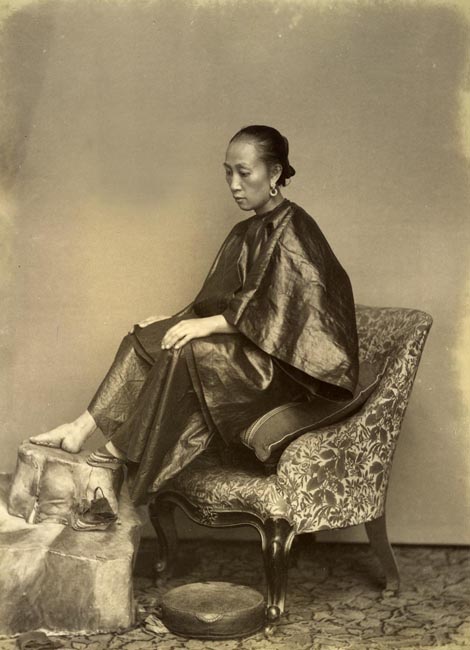
Chinese woman with feet re-shaped by years of binding.

Chinese woman with feet re-shaped by years of binding.

Shoes are a huge fashion statement these days and I have to admit that I like shoes.  I don’t have a  great many and I sure don’t spend the money on them that some folks do.  But I have often said a little prayer of thanks when I’m out in the mud in waterproof boots.  And the technology behind tennis shoes or hiking shoes today is unbelievable and I’ve thought many times about the soldiers who marched hundreds of miles in rough brogans – or even without shoes; of the farmers who followed a mule and a plow day in and day out wearing hard soles and no fancy insole support.  At least we aren’t like the Chinese of 1600 – 1800 who bound up their girls’ feet creating something inhuman – I read an interview where a woman explained you started binding feet at about 3 or 4 years old, ‘when you could reason with the child about the pain.’  I could cry right now just thinking about it.

Loretta Lynn’s iconic Coal Miner’s Daughter lyrics mention “…we didn’t have shoes to wear but come wintertime we’d all get a brand new pair…” Now there’s some creative license in a song but I’m wondering if she was a little optimistic in that explanation because new shoes for a passel of kids would have very nearly required a miracle for the average coal miner.  More likely the younger children wore hand-me-downs.
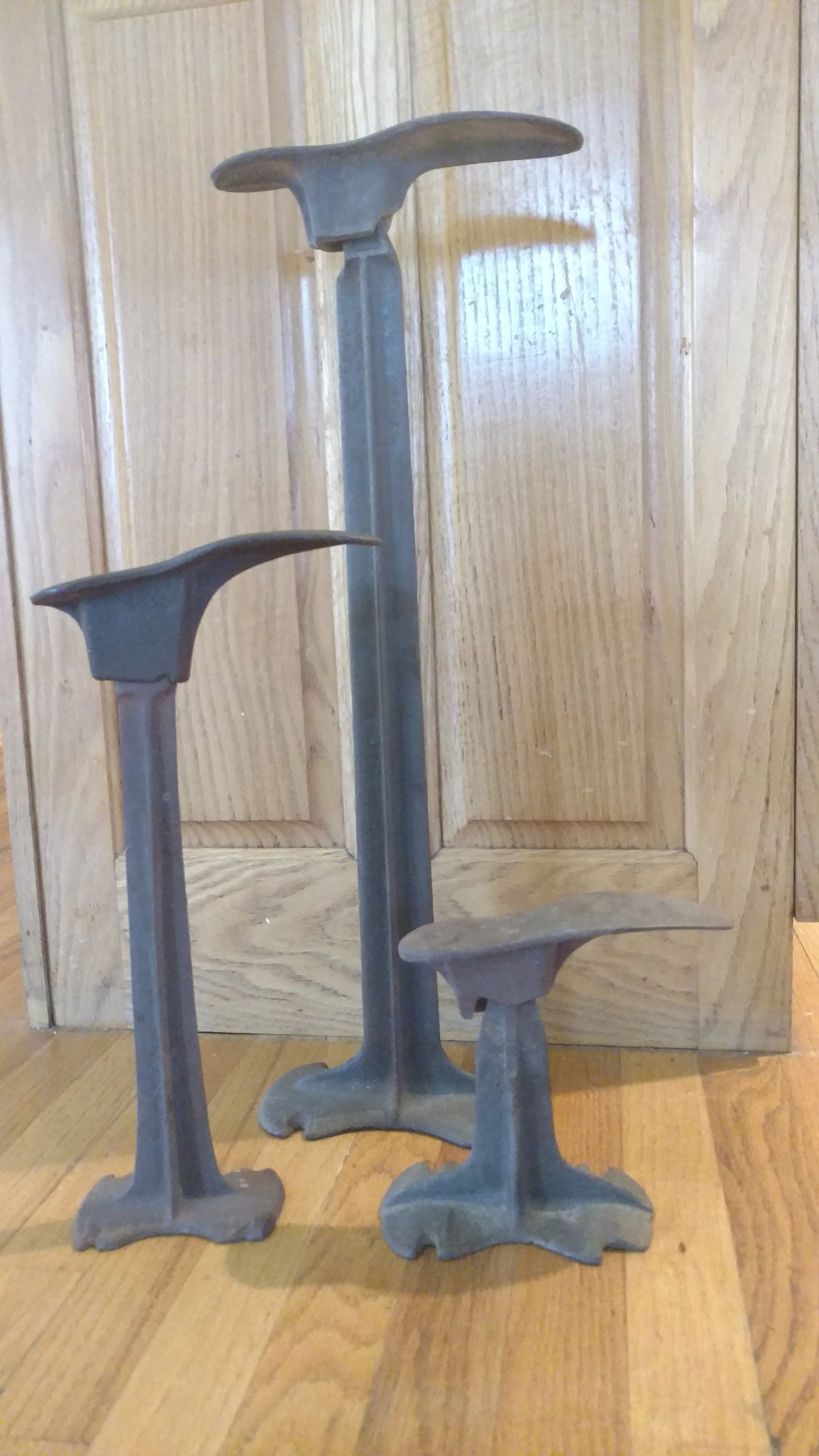
Hand-me-down shoes may have been an easier gift in yester-year when households had a shoe last  and skill to make repairs.  My great grandmother, Emma Stepp, possessed such a skill.  The story is that she could very nearly make shoes – and if she could have gotten ahold of all the materials maybe she could’ve created them from the ground up.  We have a story about her visiting with her sister one of the poor relations (which is rather a joke in itself as they were all fairly impoverished) and learning that one of the children had no shoes for the coming winter she asked her sister if she could find an old pair of shoes at home.  The next day Grandma delivered a fine pair of shoes for the child.

Cultures around the world are different and there are certainly places where good shoes are still scarce.  A girlfriend shared with me her experience on a short-term mission trip to deliver shoes.  Instead of just dropping boxes filled with footwear the missionaries sat beneath the people and fitted them with the proper shoes.  I would never have thought her proud but my friend told me how humbling the experience was for her and I can certainly understand that. Yet in bible times washing feet was an honored custom for visitors whose feet were tired and filthy from foot travel on dusty terrain. 

Isn’t that amazing to think how our perceptions have changed over a few thousand years?  We’ve gone from routinely washing another’s feet to shame at the sight of a grown man barefoot.

Under the Bluff

We have these phrases that we use all the time and I have a hard time knowing what’s our mountain vernacular and what’s common English.  So if you told me there was a spring “under the bluff” I wouldn’t think twice about it and unless I was unfamiliar with the particular piece of land I could go right to that spring. 

After the recent article about water, I was talking with a cousin who hasn’t lived on the mountain in nearly seventy years.  He made that very statement about our grandparents' old place, that they had a spring under the bluff.  Somehow it surprised me to hear him use that particular phrase and it got me to wondering whether that’s regional or widely accepted.

A little internet search for the term “bluff” – which I really thought everyone would know about – yields a definition from Oxford Dictionaries lacking any reference to a rocky overhang.  What do you reckon people call that thing because I think bluffs appear all over the place, not just in the vicinity of the Cumberland Plateau?  Well, “The Free Dictionary” does reference, “a steep promontory, bank, or cliff” so I guess it’s not totally foreign.

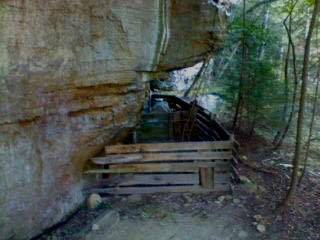
The mountain has plenty of bluffs – and they can be a welcome respite in the summer for cool shade, in a rainstorm or blocking the wind on a cold winter’s day.  Our Native American predecessors made good use of them if the arrowheads found under them give any indication. (And maybe you'll remember the story here about the Indian Painting under the bridge rock.)  We even have a story about some men working away from home; their boarding house went up on the rent so they just set up housekeeping under a bluff. 

Water Fall.jpg

Now spending some time under a bluff is not akin to living under a bridge – it’s usually quite nice under the bluff and since bluffs aren’t generally good building sites, most of the ones I can think of are off to themselves in the woods where it’s quiet and there’ll often be water dripping off the roof so you have that gentle sound.  A story about living under a bluff isn’t a sad one really.

If you’ve got a good-sized bluff on your farm it’s also a fine place for keeping stock, especially hogs since they are shorter than cows and these openings are sometimes small.  In the Big South Fork National River and Recreation Area there is a bluff where two different families kept their hogs and the fencing around it is still kept intact.

In my latest novel, Plans for Emma, a young man sets up under a bluff for a while and he’s doing just fine at that point.

I want to give special thanks to Scott Philips of Backwoods Adventures for sharing today’s pictures.  If you’re planning a visit to the Big South Fork, Scott can sure show off the bluffs there.

Now I’d love to hear from you – is this still a common expression for you?  If so, be sure to let me know where you live or where you’re from because I’m very curious how far this saying reaches.


Engagements, Rings and Weddings

Over the Christmas holiday my niece, Anna Grace Lane, accepted a marriage proposal and a ring from Mr. Cody Hull.  So you can imagine the big topic of conversation these days is wedding plans.   As usual, I’ve found myself comparing what seems to be the norm today with the approach my grandparents’ generation, and those before, took to weddings. 

I had already been thinking along these lines after the proof-readers of my latest novel asked for more details of the protagonist’s wedding.  Each one of them was disappointed when I expressed that mountain weddings of the late 1800’s weren’t very grand.  So I thought I’d share some of my research with yu’ns.

The very stage of being engaged is the first difference.  Remember the Christmas story?  Mary was “espoused to be married” to Joseph, not a term we use today and their process of marriage was different too.  The first step of marriage in ancient Israel was a betrothal which involved a would-be groom giving a gift to the girl’s father and reaching an agreement with him.  This was a firm commitment.  Months or even a whole year would pass before the wedding festivities which might last for days.  Only then would the couple be considered married.

In fact there seems to be a difference between being engaged and just plannin’ to get married.  In the past, couples simply decided to marry and did so pretty quickly thereafter.  You may recall the recent article about my Aunt Janavee Sisco whose intended husband was working up north.  Janavee had spent a few weeks visiting her brother in Dayton, Ohio when she and Willard Sisco deepened a lifelong friendship.  The two had grown up just across the holler from each other and Willard’s sister had already married Janavee’s brother.  They decided they would marry but it was time for Janavee to return to Tennessee.  Willard came home shortly thereafter and as he told me he decided he’d better go ahead and marry her before someone else did.

It seems like a familiar sentiment; another great aunt remembers asking her mother’s advice on a proposal.  “If you don’t marry him somebody else will,” was the wisdom my great-grandmother imparted. 

Willard and Janavee drove to Georgia because Tennessee required a blood test and two week wait for results.  Clyde Whittaker and Ellen Bilbrey drove up to Jamestown, Kentucky and why they went north instead of south Clyde doesn’t remember sixty-eight years later.  He does recall that most folks who didn’t want to wait two weeks for their blood tests went ‘down toward Chattanooga’.

We’ve talked here about some traditions when we talked about  a traditional Appalachian wedding cake and the saying that the number of layers in a bride's cake reflected how beloved she was.  However, among our mountain folk, I can’t find any stories of church weddings – even simple ones before 1950, and not many until the mid 1960's.  June Howard told me a few years ago that “most people got married at the preacher’s house, usually in front of the fireplace.”  That’s the exact location Clyde and Ellen chose, however, they didn’t particularly know the Baptist preacher who married them – they’d stopped in a restaurant and asked where they might get married.

Then there’s the question of a ring… I heard an advertisement for Tiffany’s recently claiming they invented the modern concept of engagement rings.   However, Wikipedia traces the tradition back to Rome.  Either way, we’ve come to expect an engagement ring and I see lots of young ladies wearing diamonds that I can’t imagine their grooms paying for.  Remembering our comparison with Israeli traditions?  That region doesn’t use engagement rings and actually wear their wedding rings on the right hand.  The tradition of diamond rings really rose after the output from African diamond mines exceeded one million carats per year in 1872.  That tradition greatly declined in America after World War I and certainly during the Depression years. 

Still the secluded Appalachian peoples had their own traditions when preachers rode a circuit and gold was reserved for coins that rarely entered a mountain home.  When I’m researching genealogy I’m surprised how hard it is to find marriage records.  It was a long way to the county seat in those horse and buggy days and I wonder how many vows were said before a preacher that were honored for a lifetime despite never being officially filed?  Early marriage licenses were issued by churches; in 1837 the United States began issuing marriage licenses from the state. 

The idea of a church ceremony was completely foreign on the mountain except for the very well-off.  I’ve tried to question why simple church weddings weren’t conducted without flowers or pageantry and the only answer anyone could offer was that so many people went to Georgia that it was never practical to plan even a simple wedding.


See, here is water

You don’t need me to tell you that water is essential to life.  Our bodies are almost three-fourths water and failure to drink will kill you in just three days.  The Bible mentions water 396 times; we all know the analogy of washing away our sins and water baptism is given as the image of that supernatural cleansing. 

I’ve mentioned here before that running water is probably my favorite modern convenience and I might reiterate that now.  But a story from a friend recently got me to thinking about how people must have thought about water in years past.

My pastor’s family had a bug going around the week before Christmas.  After it hit the five year old boy and Daddy, their eighteen month old daughter came down with it.  Mama held her a night and a day as she repeatedly threw up and her Mama spooned water into her little mouth.  By the afternoon it became obvious that they weren’t winning the battle to keep her body hydrated so the short drive was made to the ER where an IV quickly pumped life-giving fluids into her veins.  Wow, volumes of articles could come from that little paragraph, even historically-minded articles.  After all, how long have we even known about IVs, when did they first start giving fluids intravenously and then there’s the recurring discussion of readily available medical care.

But I couldn’t help but think about the wisdom my friend had in patiently trying to get water into her little girl.  The image of a mother holding an ailing child is both heart-wrenching and familiar.  You don’t have to be a mama for long before you’ve spent hours rocking, walking, and crying right along with babies while they fight their way through everything from teething pain to nightmares.  Very often it’s hard to know just what to do.  Sometimes we wait longer than we should to get expert help and sometimes we rush off to the doctor only to be told it’ll run its course.  Have you ever asked yourself how much harder it was a century ago?  I guess families were much larger so maybe young girls learned as their own mothers face childhood issues and every community seems to have had a “granny-woman” who was the expert they turned to when something was wrong.  Yet even those wise women had few tools at their disposal save local herbs.

The need for water is surely one of those things God put into man from the beginning.  Yet I wonder whether just a couple of generations ago folks really understood how quickly the body becomes dehydrated and how debilitating dehydration can be? 

In thinking about this subject and doing a little research, I was surprised to learn that some dreaded diseases can actually be treated almost exclusively by rehydrating the body.  Plagues of Cholera have recurred since the early 1800’s.  As recently as 2009 there were over four thousand deaths in Africa due to the infection.  While antibiotics will shorten the duration of a bout, really all that’s needed is to sufficiently rehydrate a patient.  Of course, contamination of drinking water is the prime cause of Cholera outbreaks so those conditions would leave little hope of treatment.  I suppose a basic understanding of that particular disease – which didn’t come about until the mid-1800’s – and a knowledge of whether your water supply was pure would be imperative to preventing and curing it. 

A good source of water has always been a settler’s first concern.  When you happen upon old home places you can often still find the spring that delivered that family pure water.  Sometimes you have to look a little bit because families were accustomed to carrying water a long way and a spring might be shared by several families. 

My great-grandparents, Billie and Ida Key, lost a son to Typhoid in 1926.  With seven children in the house, when they were told the well was infected the family abandoned their home.  Despite no one else coming down with the fever, it surely couldn’t be risked that the whole family would take sick.  Whether a residual fear or just bad memories but after a few years working in Harriman the Keys returned to Martha Washington but never again to that home even though they kept and worked the farm.

People who live close to the land always appreciate a good source of water - whether rains for crops or collected water for stock or fresh water for the family.  Springs that haven’t been plowed and destroyed are still prized and many of you will remember as I do stopping in the woods for a drink of the coldest, clearest, best tasting water you can ever find.

Gingerbread houses and other Christmas Decorations

Christmas time is a great opportunity for crafting and creating homemade treasures.  My children made a gingerbread house this week.  Now, it was just from a kit and was super easy because the actual gingerbread was already made and perfectly formed with right angles and everything.  But it did get me to wondering what is the history of making and decorating gingerbread in the shape of houses and such?

Turns out this tradition of adorning gingerbread houses is very old and comes from the same country that tradition says gave us the Christmas tree – Germany.  According to Wikipedia, in the 1600’s in Nuremberg, Germany the baker’s guild used both master bakers and skilled craftsmen to “create complicated works of art from gingerbread.” The racing gingerbread man is a little older, dating to the 15th century.  European’s took their gingerbread-making pretty seriously, forbidding anyone except the professionals from baking it except at Christmas and Easter in the 17th century.  They were given as gifts to both children and adults, particularly at weddings where guests might each receive a figurine.

World's lagest Gingerbread House in Bryan, TX

World's lagest Gingerbread House in Bryan, TX

I also got to thinking about decorations historically.  Today we love brightly colored electric lights – you can even have flame-less and wireless candles these days.  Big displays can be remote controlled and lights can be projected in intricate shapes on high points.  (Just as an aside, we went to view a light display in town and there were tons of lights way high in the trees. I kept asking, how did they get them up there?  Well, they didn’t – they were projected up there!)

However, in the not very distant past, Christmas baubles were a luxury most on the mountain couldn’t indulge in.  But this holiday started in the humblest of locations – an animal stable with a babe lain in a manger.  It stands to reason God would provide options to adorn the holiday.  Holly with red berries is one of the cheeriest sights in a winter landscape and as I mentioned above the Germans really developed our modern tradition of decorating a tree at Christmas back in the 1500’s when devout Christians brought decorated trees into their homes.  This was largely a tradition of Protestant Germansand one that immigrated with them.  However, by the mid-1800’s the noblemen of Europe had embraced the tradition and Christmas tress could be seen from Austria to France and the young Princess Victoria wrote about them in her 1832 diary.  Marrying her German cousin, Albert, no doubt helped to further establish this tradition among the English.  Godey’s Lady’s Book even featured an image of Queen Victoria and her family around their Christmas tree.

Those early trees were decorated with sugar-ornaments, fruit and nuts.  Not until the mid-1800’s did German entrepreneurs begin making glass, paper and tin ornaments for the trees.  That idea caught on fast and by the end of the century the decorations were being exported to America.  By 1890 Woolworths was selling $25 million worth of them – and that was at a five and dime.

So the Son of God came to earth as a baby over two thousand years ago.  But the traditions most of us will observe this weekend are only about two hundred years old.   

I hope you have a very MERRY CHRISTMAS.