Tennessee Mountain Stories

Harvest Season

The picture leading this blog is from our church bulletin last week.  Don’t those little folders have some of the prettiest pictures?  Well this one is such a familiar scene that it got me to thinking about the memories of the season.

There’s something heady about the harvest season.  The air is cooling (cooling slowly this year), the leaves are hinting at the autumn-brilliance they’ll soon wear and the work of summer is drawing to a close.  Of course the work on a farm never ends and there are certainly hardships in winter.  But we don’t think about those things in the fall.  Instead, we can look at clipped fields and barns bulging with winter stores.  We see the garden turned and waiting for a little grass cover for the winter.  The can house is filled, kids are back in school and it’s simply time to take a deep breath.  All of this is a beautiful picture of God’s blessings.  Even in droughts or floods, when it’s too hot or too cool, when the bugs eat more than their share or disease hits the crops, God blesses us. 

Some things never change.

I think our forefathers more keenly felt this reliance on the land – and on God.  Of course, from way back in Bible times people have been getting the idea that they can manage on their own and don’t really need God.  Every one of those ideas ended badly of course.  It seems to me that it’s getting easier to make that mistake these days.  Now we think we can get a public job and buy our groceries from the store if the crops don’t do too well.  Food does seem to magically appear on the shelves, doesn’t it? 

In 1906 Alfred Henry Lewis said, "There are only nine meals between mankind and anarchy."  There's a whole prepper movement afoot today that would probably agree with him, citing that in most homes all the food they have in the house would maybe last nine meals.  Can you imagine what your grandmothers would have said to that statistic?  It would not have been kind!

Barring years of very severe weather and long economic hardship, most mountain farms could go months without a trip to the grocery store.  In fact, many never expected to visit a store more than once a month.  And those visits only brought home coffee, a little sugar and maybe a treat for the kids along with a few dry goods.  Of course, you might have to take a turn of corn to the gristmill, otherwise you’d be eating gritted bread.  And your menu might be a little limited, but don’t most of us eat pretty much the same things all the time anyway? 

For those hard working farmers, if the cow doesn’t go dry, the root cellar doesn’t flood and the barn isn’t hit by lightning then there’ll be something in the pot through the cold months of winter.   Do you think that’s why fall is such a beautiful season?

Making a Mark on the World

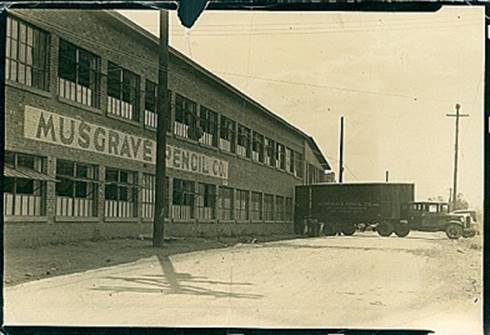
Photo courtesy of Musgrave Pencil Company, www.pencils.net

Photo courtesy of Musgrave Pencil Company, www.pencils.net

I’ve told you many times before that these blog articles are chiefly driven by research for the novels I’m writing.  In my latest book Plans for Emma, I have her grabbing a pencil at one point.  While it may seems a strange thing to research, I heard someone talking about quill pens and ink wells and then I wondered just when did we have ready access to pencils. 

Usually when I have a question like this, a quick internet search reveals a date and I move right along.  However, when I queried the history of pencils what I learned about Tennessee history was so fascinating I wanted to pass it along.

We know and have surely established on this website that Tennessee has been rich in many natural resources, not the least of which is timber.  In fact, the timber industry is also central to the story in Plans for Emma.  In that story, timber is being harvested for railroad ties as many thousands of trees on the Cumberland Plateau were.  But did you ever think about what other uses Tennessee timber went for? 

According to www.Pencils.net, Eastern Red Cedar was the wood of choice for early pencil production in America.  This wood was strong enough and did not easily splinter in the writer’s hand; it grew in the Southeastern United States and Northern manufacturers set up wood mills near the source of timber.  In the nineteenth century, Tennessee had the greatest concentration of U.S. pencil manufacturers.  While this industry has seen the same movement of manufacturing out of the states, those pencils produced in the U.S. are still primarily made in the South. 

Photo courtesy of Musgrave Pencil Company, www.pencils.net

Photo courtesy of Musgrave Pencil Company, www.pencils.net

Musgrave Pencil Company in Shelbyville actually bought cedar fence rails from farmers and made those into pencils.  They cut the rails into pencil slats which they shipped to German manufacturers.  Germany had pioneered pencil production way back in 1662.  Eventually Musgrave began making their own pencils, even after the timber source in Tennessee was depleted.  That company is still producing pencils in middle Tennessee.

Not just home for prized Walking Horses, Shelbyville became home to several pencil manufacturers and still hosts Musgrave, as well as pencil imprinters Shelbyville Pencil, and Atlas Pen and Pencil.  

Photo courtesy of Musgrave Pencil Company, www.pencils.net

Mountain Family

Family is a precious thing.  I’ll tell you right up front here that I’ve got tears in my eyes as I try to share these thoughts with you.  Some of my friends have been giving me a pretty hard time lately about all of the family reunions I’ve been to this summer.  I wouldn’t give up a single one of them!

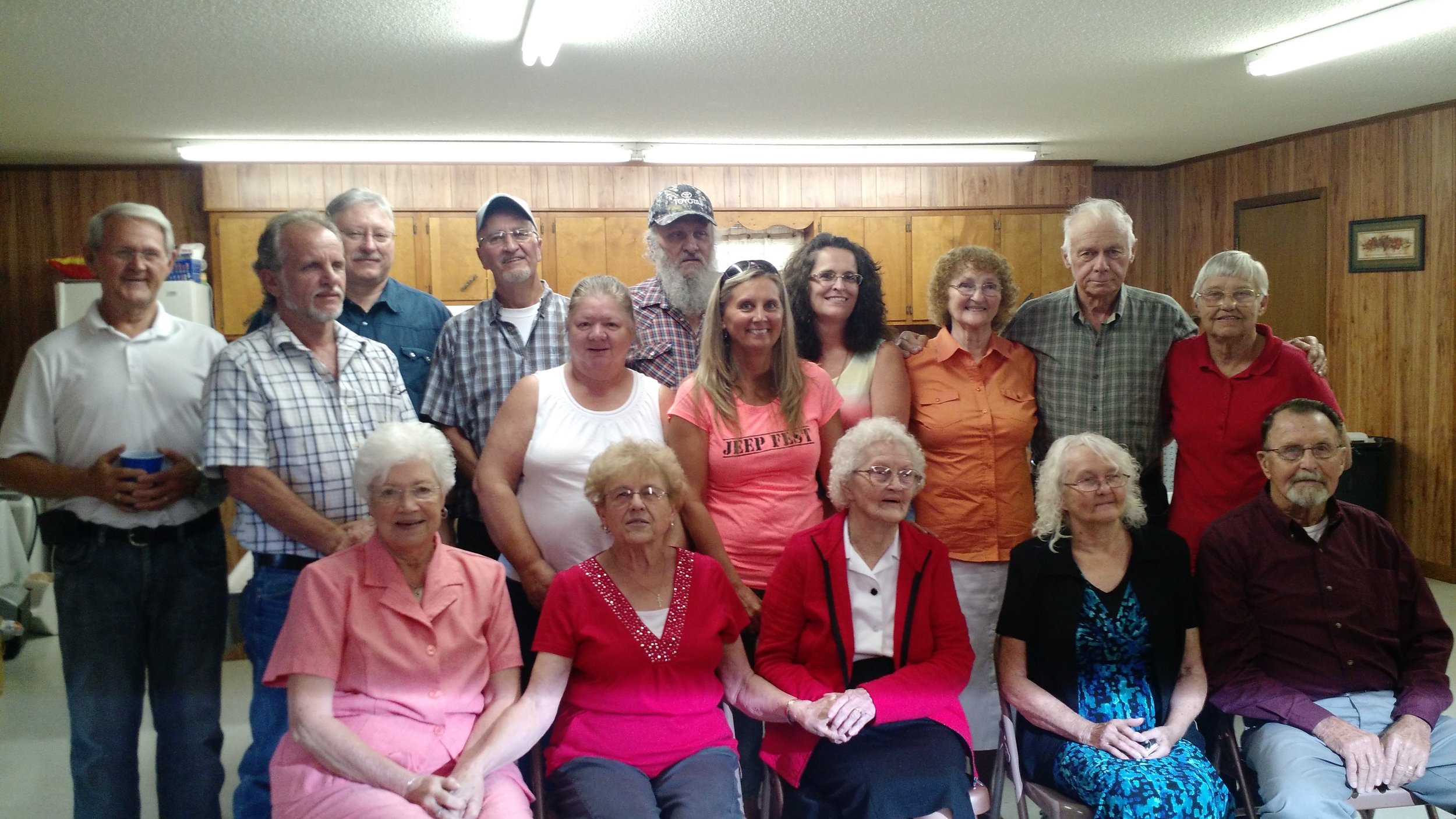
Last Saturday the Key cousins got together as they’ve been doing every September for nearly thirty years.  The faces change some from year to year either because life just gets in the way or sickness or the passing of a generation.  But every face in the group is precious – they are family and to mountain-folk, family is pretty much second only to salvation in importance. 

Melissa Copeland.jpg

This week we had a 92 year old cousin (she’s seated in the very center of the group picture).  While Velma has suffered from a stroke in the past few years, she still walked in on her own and beamed at every one of us.  And I got to visit my best friend from elementary school.   Melissa and I were in school from kindergarten through twelfth grade and I promised I wouldn’t tell how many years ago that was.

John Wesley Key and Sarah Anne Key

John Wesley Key and Sarah Anne Key

John Wesley Key and Sarah Anne Key birthed nine children from about 1883 till 1900.  Of course none of their children were with us, but three of their grandchildren were there.  Velma, who I’ve already mentioned, as well as Betty and Freda were there.  Eight great-grandchildren and two great-great-grandchildren as well as four folks that were wise enough to marry into this great family.  When you see extended family like this, it makes me think of God’s promise to Abraham in Genesis 22:17, “….I will multiply thy seed as the stars of the heaven, and as the sand which is upon the sea shore…” I’m sure John and Sarah never dreamed they’d still be remembered and celebrated nearly 100 years after their passing or that they would be represented by so many descendants.

I’ve said this before and if you stick around the blog, you’re gonna’ hear me say it again.  Go to your family reunions, don’t lose touch with your cousins.  Family is an incredible blessing – even if you can’t identify with everyone of them.  Even if some of your family doesn’t quite do things the way you want, they are still family.  And you will never influence those you never know.


Snuff Glasses – and other useful Re-Useables

There’s a popular movement in our world today to “reduce your carbon footprint” and “recycle today for a better tomorrow.”  Well let me tell you, on the mountain we are recycling experts and have been for generations.

I recently saw a picture that included a snuff glass – or at least it looked just like some of the snuff glasses I have in my cabinet and it got me to thinking about how disposable our world today really is.  

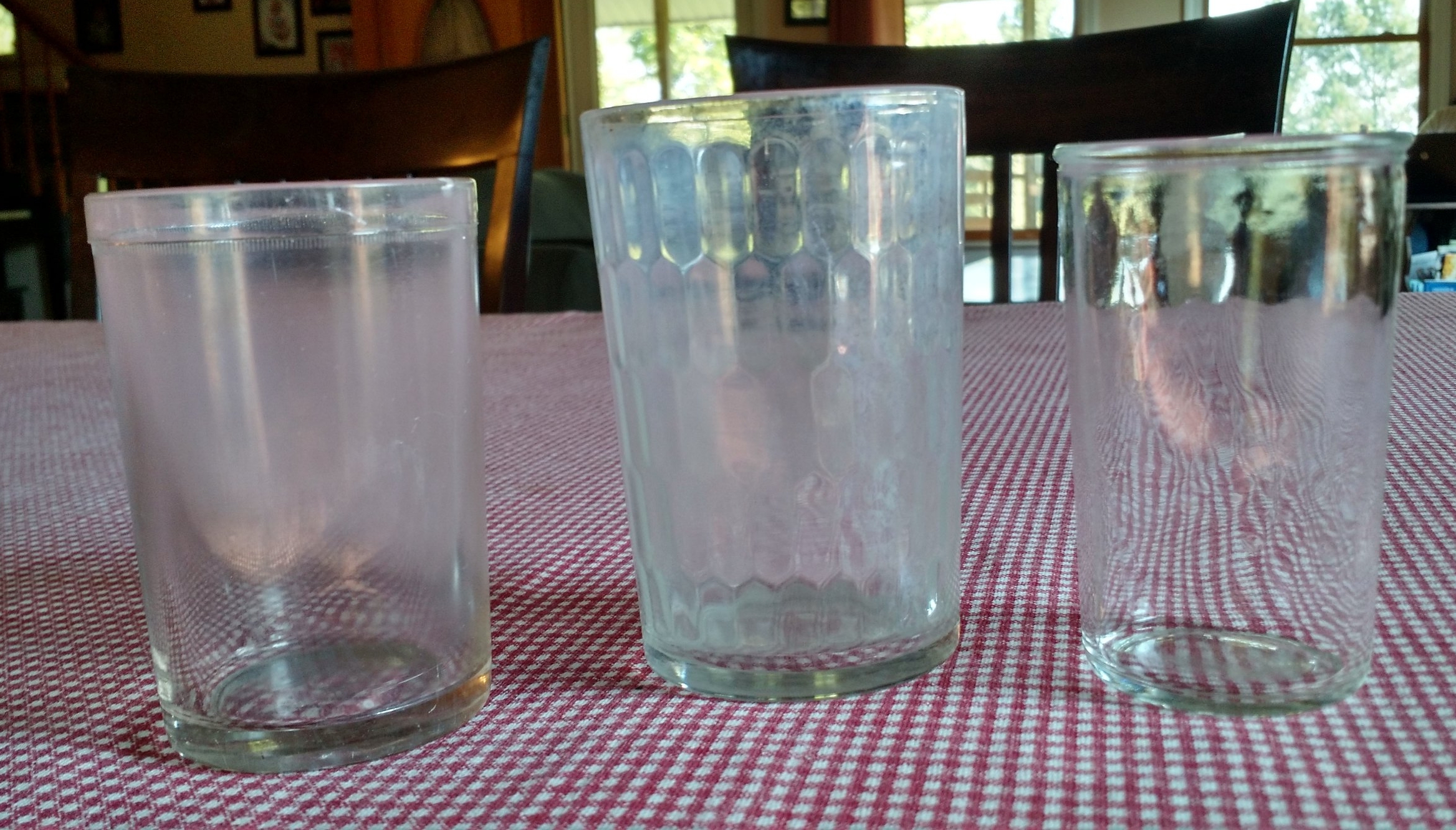
Dipping snuff is a pretty disgusting habit in my estimation but two generations ago many folks, even women, partook of it.  Snuff was packaged both in tins and in glass jars.  The jars were perfectly sized for drinking glasses when they were empty and every household kept, washed and reused them.  Even I grew up drinking out of snuff glasses – they were just a normal part of the kitchen.

We’ve talked here before about cotton feed-sacks and the many uses they have – volumes could be written about feed sacks.  But now I’m wondering if there have been other packaging that were readily reused. 

Of course heavy brown paper was used to wrap many packages and tied with course string both of which would be smoothed out or wound up and saved.  If you ever carried your groceries home in a poke you wouldn’t dare throw it out and a wooden crate intended for apples or oranges had a thousand uses. 

We never throw anything out because as soon as you trash it, you’re sure to need it.  The idea of ‘use it up, wear it out, make do or do without’ may not have originated on the Cumberland Plateau but we have certainly embraced the concept. 

IMG_20160910_093205136.jpg

Canning jars are almost like gold to families that garden and preserve.  So mayonnaise and syrup jars were carefully saved.  Even today if I have a chance to buy food in a reusable jar I can’t help but buy that brand.  Bob White syrup is the brand that lasted into my lifetime in canning jars.  It came in a jar that held three pints – so we always call those “syrup jars” and when reporting how many beans you managed to can you have to count pints, quarts and syrup jars.

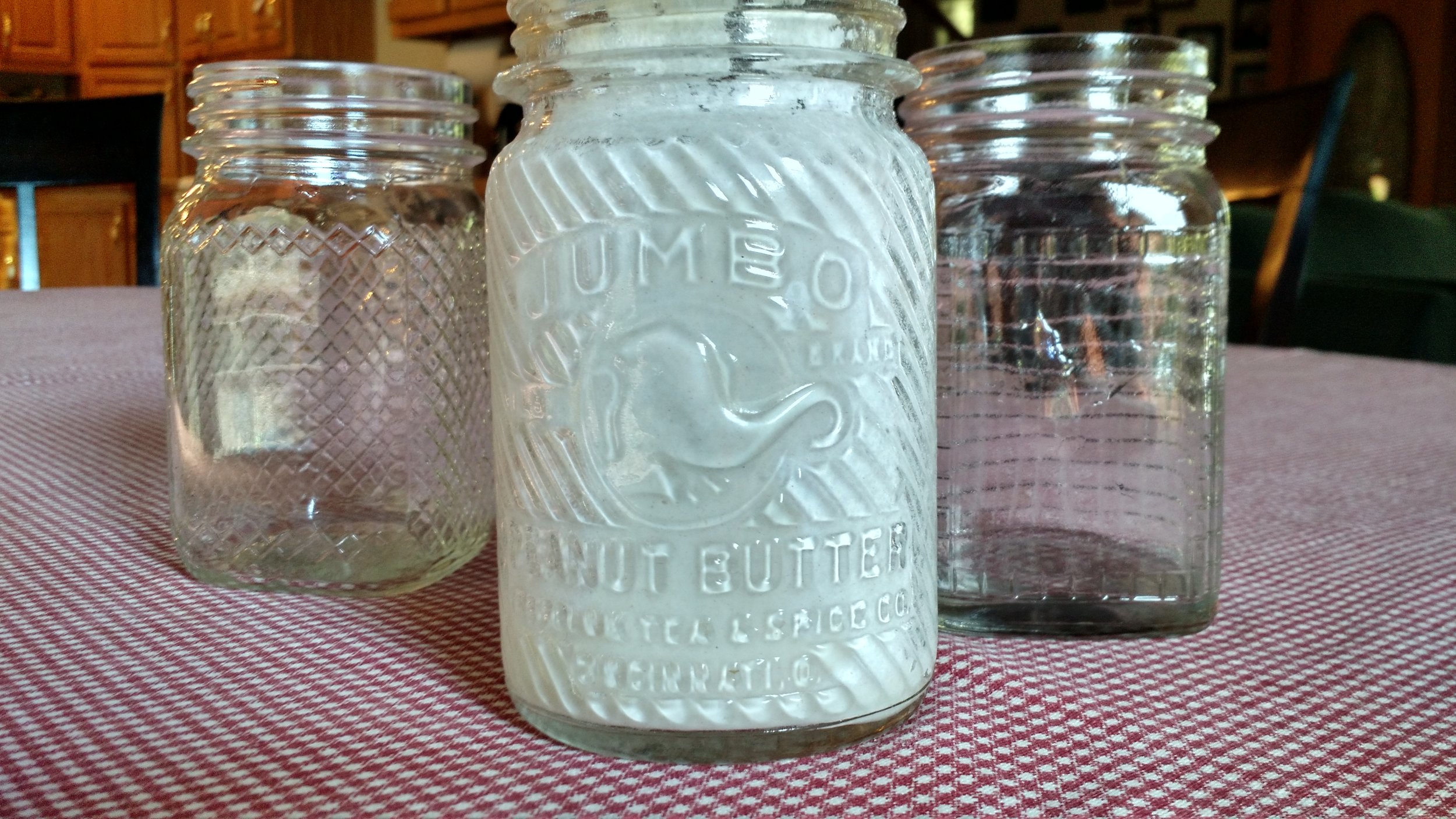
Peanut Butter jars - the Jumbo jar is clear but I filled it with flour so you could see the logo.

Peanut Butter jars - the Jumbo jar is clear but I filled it with flour so you could see the logo.

Many historic companies understood our penchant for getting a little extra for your money.  The feedsacks that started out as plain fabric were dyed in pretty patterns when companies realized the fabric was being recycled as curtains or dresses.  It was a simply a marketing tactic.  Well other companies packaged in the box other premiums. 

For many, many years, oatmeal included a piece of cut glassware.  My grandmother had all kinds of these glasses which were unfortunately lost in a fire.  When I see those glasses on antique store shelves I wonder how valuable her collection might have been.  Dove washing powder had glasses – bigger boxes had stemware, medium sized had tumbler and the small boxes had juice glasses.

Grocery store owners were also paying attention and offered S&H Green Stamps, or their own private coupons, to redeem for dishes.  I wonder how many families grew up eating on grocery-store tableware?  JFG and Arbuckle coffee encouraged drinking their brand with similar coupons that you could exchange for all kinds of merchandise.

It’s really funny to me that we live in this disposable world now – where it’s often cheaper to buy a new computer printer than to replace the ink.  Where replacing the battery on a household tool can be so difficult that you just throw it out despite the years of use it might still have.  Yet, we have these groups always talking about saving our resources.  Maybe we need to invite those groups up to the mountain to see how we’ve been living all along!

I’d love to hear from you folks about what items you may still be using that were originally meant for packaging or maybe were found in boxes of some other product?


Mail Order

I’m a catalog shopper.  I often say that I lack the shopping gene.  I’d rather face a hard day of field work than a day at the mall.  I guess if I’m going to be crowded I’d rather it be trees that won’t push or shove or try to pick my pocket.  So I do my shopping via mail order, just like my grandmothers and great grandmothers for generations.

We’ve established here before that I’m pretty spoiled.  Even though I enjoy history and historical things; even though a part of me longs for the “olden days”, there’s another part of me that really enjoys some of our modern conveniences.  I am spoiled to being able to track my packages online and know where my order’s at and when it’s coming.  I’m spoiled to being able to look online and see all the choices that a company has and not just what they were able to print in the catalog that they sent me in the mail. I recently realized that I’m really spoiled to the speed of things we enjoy today.

I found a great buy on a brand name pair of shoes.  I ordered them and I’ve been waiting three weeks for them.  Now it’s not been very long ago that the standard shipping time for a catalog order was six to eight weeks.  Three long weeks I’ve been waiting; I still don’t have my shoes and I’m about to give up on them.  So I tracked them online; they came straight from China – I guess it really is a slow boat from China!

Sears Home number 52, Price $782 - $1995From the Sears Archives

Sears Home number 52, Price $782 - $1995
From the Sears Archives

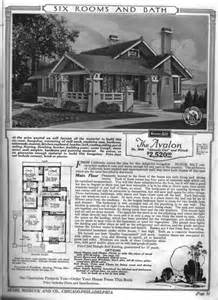
This experience got me to thinking about ordering so many things that your family needed from Sears and Roebuck or Montgomery Ward and then waiting and waiting. You could buy huge things, a Ford car or even a prefabricated house.  Sears sold about 70,000 kit houses from 1908 until 1940.  I wonder what the shipping time was for a house?

There’s a story around home about Uncle George Hall (everybody called him Uncle George whether they were any kin or not) ordering a new car sometime in the late 1930’s.  It was delivered to Peter’s Store and word was sent to him by the next customer that headed toward Roslin.  Until he could make it to the store, the shiny new car sat in the “parking lot”.  It was the only car sitting there and got plenty of attention.

Some of the catalogs I particularly enjoy getting are the seed catalogs that start showing up late in the winter.  By that time I’m tired of being cold, tired of dreary overcast days and I’m looking forward to the first blooms peeking out of the leaves and getting out to plant the garden.  I’ve ordered seeds a number of times, although my garden planning is usually left till the last minute.  In fact, I’ve been known to be scrounging around trying to find tomato plants – why do those things sell out so quickly?  So if you have to make out your seed order, mail it in, wait for it to be received by the seed company, then they’ll package your seeds and send them to you.  You’d better be on top of things and get that order out good and early.  I guess in an agrarian home even though the winter can involve a lot of hard work, there is some free time you don’t have during the warmer months so there’s maybe more opportunity to get your seed order made out.