
Tennessee Mountain Stories

2015 in Review

Well I hope that everyone had a merry and blessed Christmas.  It was a little damp on Christmas Day in Tennessee but we were thankful for a dry home and all of my family was able to safely meet and celebrate the birth of our Lord and Savior Jesus Christ.

Now we look toward starting a new year and I thought I’d share some thoughts about 2015.  Last January, I shared some goals here; there can be no purpose in goals if you don’t ever look back to assess your progress, so here goes.

I have long realized that we are quickly losing lots of knowledge and history as a generation passes away from us – and it is a great generation that now finds itself drawing old age pensions and occupying nursing homes.  And more of them passed into eternity in 2015 taking with them stories that can never be retrieved.

I said I was going to VISIT and I’m feeling pretty good about my efforts – in a way.  This year I was able to visit two relatives who are in their nineties.  My Aunt Willie is ninety-nine years old – she’ll be one hundred next month!  Her mind is very sharp but her hearing isn’t quite as good so it’s a little hard to interview her.  Still, she talked about memories and friends from long, long ago.  She’s lived in West Tennessee for many years so she always asks about people and things from home and that prompts her memories.  It’s wonderful to have the different perspectives on family history because we all remember different details and her feelings about events are different than others.

My cousin Clyde is a ninety-one year old World War II veteran whose memory is as sharp as a tack.  He has spent all of his adult life away from the mountain and both the stories of his life away as well as his memories from home keep me spellbound every time I get to talk to him.  I really need to share his stories with you and I certainly plan to do that in 2016.

One ninety year old cousin, Velma, has unfortunately suffered a stroke that has left her unable to really communicate.  However, these story-tellers have passed along their memories throughout their lives and her son Ray shared a lot with me.  His grandfather, Carson Key, left books of stories and I will plan to share some of those with you.  

This year we lost one cousin who was eighty-nine years old.  June Howard was probably the sweetest person I’ve ever known.  She left a wealth of photographs that are labelled not only with names and dates but also with locations and events.  Doesn’t that inspire you to work on your own pictures?  That is an ongoing project of mine but I confess I’m a long, long way from finished.

In writing progress, I was able to release Replacing Ann this year and you all greatly honored me by downloading it as well as buying hard copies.  Hall Family Pharmacy very kindly placed the book in their store in Jamestown so it is available to anyone who prefers a paper copy.  You can also order it from Amazon.

Changes in the literary agency that represents my writing allowed me to begin working with Tamela Hancock Murray who promptly challenged me to write in a slightly different genre.  I have been steadily working on that assignment and expect to have a first draft of Emma in January.  (Yes, I realize that Emma is the title of a classic Jane Austin novel and I won’t release my book by that name.  However, it’s the name of my main character and until I settle on a title, I always refer to the books by the character’s name.)  It will be my hope to announce publication of that book to you in 2016 – you’re welcome to pray with me toward that end.
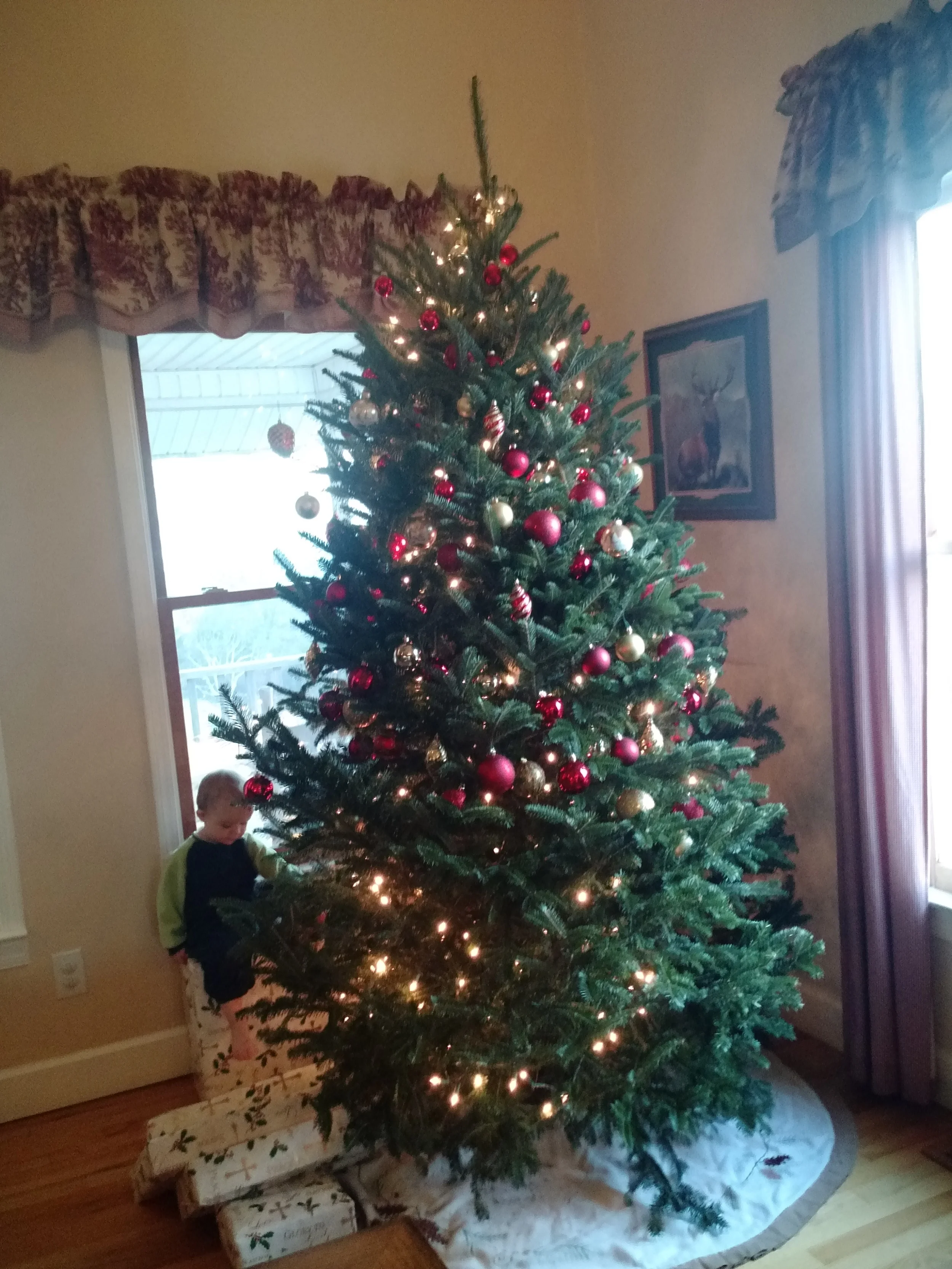
Have you ever seen a Christmas Tree decorated quite like this? 

Have you ever seen a Christmas Tree decorated quite like this? 

Finally, life in general is a never ending saga of joys and heartbreaks, victories and challenges.  My days are filled to the brim with two toddlers who are learning, growing, and changing every day.  I think I’m going to remember every detail of these days and then I look back at pictures from just a few months ago and think, ‘Where was I?’ because I don’t remember that happening.  I’m going to share a picture of my Christmas tree – it’s the best way to describe my days.

Thank you for sharing 2015 with me – I’m looking forward to 2016 and am eager to share what I’m learning!


Mountain Music

Musical Notes jpg.jpg

I’ve been sharing some of what I’m learning from Raine’s The Land of Saddle Bags and he includes a small section on Mountain Songs.  I was particularly interested in this section for acouple of reasons.   I’m a fan of Bluegrass Music and I’ve had the occasion to argue the point that while Bill Monroe may be nicknamed “The Father of Bluegrass Music”, the music is actually as old as the hills – or at least as old as our occupation of these hills.  I am also interested because despite my very, very limited talents my family historically was quite musical and passed many idle hours “making music”.

James Watt Raine certainly validates my “old as the hills” argument simply by including this chapter in his 1924 book.  Bill Monroe was just thirteen when this book was published and while he was undoubtedly already pickin’ his mandolin, he wouldn’t be playing publicly until the early 1930’s and would sign a recording contract in 1936 along with his brother Charlie.  Now, I don’t want to minimize either Mr. Monroe’s great talent or his contribution to Bluegrass Music.  Certainly this modern genre of music is called Bluegrass because of Monroe’s band.  Before Bill Monroe, mountain folk just called it music.  Mountain folk who’d left home might have called it Mountain Music

The Land of Saddle Bags presents seven traditional ballads – for Mr. Raine asserts that “ballads are the poetry of primitive people” and he seems certain these were the songs originally brought to Appalachia.   Only one, Barbara Allen was really familiar to me.  He also mentions:

Turkish Lady
Lord Thomas and Fair Elender
The Two Sisters
The Gypsy Laddie
The Green Willow Tree
The Demon Lover
Come all ye Fair and Tender Ladies

We may not recognize these particular songs, but we all know that we hear the twangs of Scotland and Ireland in so many of our folk songs.  Now, I have to confess to you that I tried to prove this point by looking at lists of traditional Irish and Scottish music and I’m afraid I didn’t know many – or any – of the songs listed there either.

I've shared this newspaper photo before but it's a great shot of my Great-Great Grandpa with a bunch of the instruments he made.

I've shared this newspaper photo before but it's a great shot of my Great-Great Grandpa with a bunch of the instruments he made.

My Hixson ancestors lived in the Sequatchie Valley, walled in by great mountain ranges on both sides, this idyllic valley seems like something from a storybook.  And in fact, the family lived on subsistence farms and had very little contact with the outside world.  So they had to make their own entertainment.  In fact, they entertained most of the valley as they made music every Saturday night and folks wandered in through the evening to visit and enjoy the show.  The whole family took part playing homemade instruments and utilizing God-given, raw talent. 

Of course today that valley has a four lane highway crossing it and allowing residents access to better jobs and most all of the conveniences and entertainments of the world.  The same is true on the Plateau and even in the Smoky Mountains.  So has our music survived this invasion – or the expansion of our horizons?

Certainly the popularity of Bluegrass music around the world would seem to attest that old-time, mountain music is relevant even today.  And, as I said before, it isn’t hard to pick out the old-world sound even in many of the songs penned in the twenty-first century.  The musical talent petered out of my own family so we lost the tradition of jamming together, but I was so excited to see that it lives on in the family of a fellow-blogger. 

Tipper Pressley blogs at www.blindpigandtheacorn.com and in 2010 she wrote a series of articles spotlighting Appalachian music.  You can read it here, and I think you would enjoy it.  She personally remembers her family sitting around the kitchen with their instruments and in fact, they continue the tradition, as you can see in this little video which includes her children playing along.  Of course they had radio influences well before she was born, but there was then and is still a very traditional element to their music - playing songs they learned from their fathers and grandfathers.  This family is in western North Carolina and I always enjoy reading her thoughts and kind of comparing our two mountains.

There are certainly differences between our Cumberland Plateau and the great Smoky Mountains but there are also an awful lot of similarities – and music is one of them.  Tipper wrote an article about Gospel Music in her spotlight series that I closely identify with.  She talks about the hymns of her childhood and how she is moved by them far more that our modern praise music.  She writes:

“The lyrics of those old gospel songs I grew up with lend themselves to the culture of Appalachia-not that they all were written here-most were not. But the strong recurring themes of God, Jesus, love, the cross, faith, death, blood, hell, rivers, long roads, toiling, snares, mountains, lights, rejoicing, happiness, joy, better times to come, dark valleys, and loved ones calling come-fit perfectly in the mindset of most folks born and raised in Appalachia. I would go so far as to say the manner in which they were written-the words used-strike a chord with the language of Appalachia. Maybe in the same way the isolated nature of the Appalachia region played a role in the continuity of our dialect-it also aided in folks holding on to the hymns and sacred songs of our past.”


As Mr. Raine points out in his book, the old music was largely preserved, as were so many of our cultural elements, because of our extreme remoteness – just as Mrs. Pressley points out.  In some of the songs, he theorizes that words have been lost so new words were put in place – and what else would you do if you had no point of reference for the song?  Also, some words slowly change – like a ship’s carpenter becoming a house carpenter because there was no ship-building going on in the mountains.  But still we have the melodies, and still we sing the songs of our ancestors – the songs of the old country.

My cousin lives in Scotland now and regularly contributes to a newsletter for the St. Andrews Cross Society.  She usually shares it with me and I love it – I’m drawn to the history of that country.  Is it just the Hollywood presentation of Braveheart, the beauty of the countryside and age-old architecture?  Or is there an ancestral nature?  As I read James Watt Raine’s book and see how much of Ireland and Scotland we’ve preserved in Appalachia, I begin to wonder if history is leading me to identify with the highlanders.

Mountain Speech – per James Watt Raine

James Watt Raine as pictured in The Land of Saddle-bags.The brown spots are simple worn off the page of this very old book.

James Watt Raine as pictured in The Land of Saddle-bags.
The brown spots are simple worn off the page of this very old book.

A handful of you told me you would be interested in Mr. Raine’s thoughts on Mountain Speech and Song and I’m happy to oblige.  So we’ll star this article with a confession – I sure got my comeuppance preparing to write this. 

I thought I had a working command of proper English even though I often choose the more comfortable, mountain vernacular.  Could be, I was mistaken for I found words here that I still use every day – and in fact have been writing in manuscripts – believing they are good English.  (Hmm, that explains why Microsoft Word keeps flagging Church-house every time I write it; who knew that “church” referred to the building in written English?  I suppose I thought it was the people who are the church and if I referred to the building where they meet then I needed to clarify.)

As I read Mr. Raine’s chapter on mountain speech, I was thrilled to learn that many of the mountain words we routinely use are not just plain wrong, nor are they ignorant inventions.  Instead, they are the language of the great poets and playwrights - of Shakespeare and Chaucer, Milton and Spenser and of course of the King James Bible. 

He tries to address the why of mountain language and if you remember this book was published in 1924, his logic is sound.  Due to the remoteness of our land, many years passed with little traffic from the outside world that would bring slang words to infiltrate the original language of the Victorian settlers.  There have always been a few books among us and those certainly affect the reader’s vocabulary and some young’uns have gone out to school and brought back finer speech.  Any citizen of the 1920’s would be stunned by the changes we’ve seen in technology, but even then language was having to adapt to the industrial revolution and its inventions.

I’ve often heard how someone “clum the ladder to the loft” and it turns out Mr. Chaucer wrote the past tense of climb similarly when he used clomb and Edmund Spenser (author of The Faerie Queen) used Clomben.  I’ve probably recently said I “drug a stick out of the yard” and we always say if you hurt your ankle you’d better “wrop it up in brown paper and vinegar” – although that’s the only time we use wrop I think. 

Raine gives credit for modern usage in adding “ed” to past tense words such as throwed, growed and knowed – and would you even think twice if someone told you she “throwed out the garbage”?  In a similar fashion we add “es” to form plurals of both nouns and verbs since milk really “costes a lot these days,” and the Christmas lights “twistes all up when you unpack them.”

I wish I could remember which of my elementary school teachers took issue with my pronunciation of “it” preceded by an h.  I remember being seated, lectured and made to “sound out the word and write what you’re saying.”  To that well-meaning teacher, I’d like to point out, “Hit were good enough for Chaucer”.

Some of the terms Mr. Raine points out as vividly “word-making” or “phrase-making” are so much a part of the English I hear all the time that I’m struggling a little to find the fault of them.

“The moon fulls tonight.”
“Grannie’s been bedfast for a long time.”
“Children grow up directly.” (He doesn’t point out that we pronounce that “dreckly”.)
“I want to buy a pretty for my child.”

Now there are a couple of his custom-made examples that I would have used differently and I wonder if that’s a difference in Cumberland Plateau and West Virginia dialects.  While we don’t think of buckets or churns being wooden anymore, most of us would quickly understand the meaning of “the butter churh fell to staves”.  However, my use of the adjverb “common” would tend to be slightly negative – as though the person being described was not of very high character.  However, Mr. Raine defines it as “…affable, mingles with folks as an equal”.

He does include a number of phrases and terms that I am completely unfamiliar with such as:

Iron and delft – iron pots and pans and dishes

destructious – meaning clear enough as causing destruction

disfurnish – he doesn’t translates but offers this sentence: “If it don’t disfurnish ye none, I’ll pay ye later.”

half-side deepagain, no translation but it’s the measurement of a river.

wasted – used or spent but not squandered.

I continue to be amazed by our language and the longevity of these Victorian, or even way back to Elizabethan, terms.  I can’t tell you what validation it offers to hear this champion of the mountain people relating our language back to authors and poets whose work is still highly revered. 

He shares one statement from an eight year old girl when asked, “Was your new baby a boy?” she replied, “Yes, hit was a boy – and hit’s a boy yit.”

Next week we'll see what Mr. James Watt Raine had to say about Mountain Music!

**UPDATE 12/19/15

A question was posted on Facebook about our use of "fixin' to" and I am so fascinated by the results of a little research on that phrase that I wanted to share it with everyone.

According to "Words Gone Wild", the phrase "has a distinguished etymological history, dating at least to the 14th century, when fix meant “to set one’s eye or mind on something,”" and probably stemmed from the Latin fixus which means “immovable, settled, or established.”

Had I not read this, I would have guessed that the phrase came from preparing something.  For example, no one would criticize someone “preparing a meal for my family” but some would sneer at my “I’m fixin’ some supper” – but they have the very same meaning.  Well, it seems people have been fixin’ to do stuff for centuries.  In 1716 The Oxford English Dictionary cited fixing as preparing and in 1871 Harriet Beecher Stowe wrote “He was fixin’ out for the voyage” to indicate preparations. 

And for those that would say this is totally Appalachian or Southern, “In 1907 the Springfield (Massachusetts) Weekly Republic proclaimed, “What a pretty night!  The moon is fixing to shine.”


Old Time Virtues – From The Land of Saddle-Bags

A few weeks ago I told you I had a great ‘new’ book.  I may have mentioned how excited I was when I first began to read something written by one of us.  I need to reiterate that sentiment today.

Chapter four of The Land of Saddle-Bags is entitled “Elizabethan Virtues”.  Now, I doubt anyone on the mountain today would pick up a book by that title and we surely wouldn’t label anything about our way of life “Elizabethan”.  Yet James Watt Raine might well have been in one of our back yards as he wrote these observations. 

Molasses Stir Offsome 'foreign' writers might present this as a sad means of acquiring sweetener.  It was always a festive time and everyone was please to put forth the effort as sorghum was the main sweetener in their diet.  This is not a…

Molasses Stir Off
some 'foreign' writers might present this as a sad means of acquiring sweetener.  It was always a festive time and everyone was please to put forth the effort as sorghum was the main sweetener in their diet.  This is not a picture of do-less people but hard workers.

He begins, “It is perhaps inevitable, but none the less unfortunate, that most of those who write about the Mountain People do not live among them.”  Let me just begin my ‘amens’ right here.  You may recall an article I wrote here well over a year ago about Dr. Wharton who founded the Pleasant Hill hospital and worked to expand it to the current Cumberland Medical Center.  Dr. Wharton did a great work and certainly gave us a wonderful gift in the medical facility we now enjoy.  However, I took some offense to her assessment of the mountain people she found around Pleasant Hill in 1917.  Dr. Wharton was born in Minnesota and educated in North Dakota, Europe and Michigan.  I imagine early-twentieth-century Appalachia was as foreign to her as any third world country would be to me today.  And what she reports seeing is a rather bleak environment of shiftless men anfaceless women; of families scarcely eeking out a living and seeming unconcerned about their plight.  And hers was not the first such report I’ve read; rather, it is what’s represented in most books written in the early twentieth century.

In contrast, Mr. Raine presents the mountain people as a unique race.  We may get a little nervous when people start talking about race in 2015.  However, when he wrote this book in 1924, the reader might have been more open to a broad definition of racial characteristics.  In fact, he mentions that the word ‘racial’ might be a stamp of inferiority.  Some in his day had portrayed the “actions, …motives, [and] outlook upon life [of the mountain people]… as so different …that they are made to seem a strange, peculiar, and far-off people.”  That really does sound like you are describing some foreign race. But Mr. Raine asserts this extreme view is inaccurate.

Instead, he points out the geography that kept the people of the mountains isolated for so many years and therefore they have either allowed the development of resourcefulness and independence; depending on your perception, this may have been forced upon them rather than allowed by them.   These were certainly traits our forefathers brought from England, Germany and Ireland and they have endured across the years.  The book’s author even finds virtue in the mountaineer’s ‘love of leisure’ for he points out that they are satisfied with what they have and not always striving to “procure these coveted things” which others have.  I guess that goes back to our individuality and it’s one of the characteristics I fear we’re losing as the world creeps up our mountain.  We are now told what the “average” American has and think we need at least that or more.  We long to dress the way we’re told is fashionable and drive the cars that are marketed to us and even eat the food of the world. 

“The Mountain men today are called shiftless because they do not flock to the city where they might enjoy the great benefit of crowds, confusion and noise.” I've rarely heard the sentiment that everybody ought to run off and get a factory job, but I’ve sure heard a lot of folks with good jobs up north longing to be back home.  Of course there were some who remembered hunger and cold and never wanted to look back.  But so many of our folks have looked back to the mountain longingly – and many came back when circumstances allowed it.  Of those folks who did move away, they seemed to carry memories of hard working folks with little opportunity for luxury or conveniences.  They moved wherever work carried them and there they cooked the food they’d loved in the mountains – if they could get it for Poke Sallet and cracklin’s are hard to find in the city.  They plied the crafts they’d learned at home, if only as a hobby, for many still whittled and quilted.  And they taught their children the values of their homeland – a love of God, devotion to family, honesty and perseverance. 

I am thrilled to have the opportunity to write about these people and places from the perspective of “one of our own” and I love finding other people doing the same.  I find bloggers from my own generation (and maybe younger) who still live in the mountains (such as the Blind Pig and the Acorn) and cherish the old ways or those who have never really lived here but descend from families that worked in cities and loved farms (such as Appleroot Farm).

So, the next chapter in The Land of Saddle Bags is “Mountain Speech and Song”.  I’ve written a few times here about our Southern English.  What do you think?  Do you want to hear what Mr. Raine had to say about it over ninety years ago?  Please click on “Comments” below and let me know.

Family, Religion and Politics

We mountain folk are a bit clannish and proud of it.  I’ve recently been learning about our Scots-Irish heritage and our ancestors seem to have passed their devotion to clan along through the generations.  Family means a lot to us and it is largely the center of society on the mountain.  While there’s always been the occasional ‘black sheep’ that didn’t seem to fit the rest of the herd, we are usually quite alike across the family and usually across several generations.

This leads me to ponder where changes creep into families.  And nothing is more creeping than differences of opinion on religion or politics.  My own great-great grandfather, Daniel Todd, came from a family of Methodists.  He said, “There’s two things I could never be, a Democrat or a Baptist”. 

Daniel was the grandson of a Virginia plantation owner.  Our family historian has found no evidence that William G. Todd kept any slaves on that plantation yet he stayed in Russell County, Virginia until the end of The Civil War.  It seems his anti-slavery sentiments rendered him too unpopular with his neighbors and very shortly after the war he headed west.  After a few years, he settled on the Cumberland Plateau in the Martha Washington community.  He had sixteen children and while the five eldest were already adults when he left Virginia, he brought a houseful with him. 

History has not preserved a lot of either William or Daniel’s political opnions, but the Republican Party was pretty new when they presented Abraham Lincoln as their candidate in 1860.  This was the liberal party of the day, urging modernization of the economy and of course demanding freedom for the slaves.  More than half a century later, some still thought of democrats as being pro-slavery. 

The Democrats were fractured in 1860 and presented a Northern Democratic candidate on the platform of completing the railroad to the Pacific, buying Cuba and a strong support of the Supreme Court.  The Southern Democratic party’s platform read much the same but with a bit more emphasis on territorial rights and especially the clause that territories would be admitted as states whether they would be free or slave states.

When Daniel’s oldest granddaughter announced she would marry, her father’s only comment was, “he’s a Democrat you know.”  When she repeated that to her own son years later, they believed it was still the slavery issue that held the family solidly in the Republican party after nearly three-quarters of a century.

Now we know that when mountain people get ahold of a belief, we hold on strong.  But an old lady from Cooktown told me once that her family was Republican until President Hoover ‘nearly starved us all to death’ and they vowed they would never again vote for a Republican.  She was only ten years old when the stock market crashed and plunged America into The Great Depression, but she remained faithful to that vow into the twenty-first century.

Understanding the politics of the late nineteenth century and the Todd’s suffering for their decision to not own slaves, seems to make Daniel’s political party choice obvious.    Yet he raised eleven children and while his politics held strong among them, only two children remained in the Methodist church.  That trend seems out of whack since this family was much stronger in their religion than their politics.

The Todds and their descendents were faithful church members.  Daniel’s wife Lottie and his sister-in-law Gracie are largely credited with the founding of the Martha Washington Baptist Church despite their dedication to Methodism.  Walking all the way to Clarkrange from their Martha Washington homes wasn’t very practical in inclement weather, or when the circuit preacher wasn’t in attendance.  So, these ladies sought permission to hold Sunday School in the building of the Martha Washington School.  I suppose that was rather non-denominational and in fact, there were other groups represented in that congregation before it finally settled as a Freewill Baptist Church.

Daniel had only three sons but two of them were preachers, both in the Baptist church – although the younger son spent some time in the Holiness Church.  The oldest of the Todd children married a family that was charter members of the Campground Baptist Church and raised her own family as Baptists.

It’s a lot easier to research the changing positions of America’s political parties than the changing face of our churches over the years.  For many years travel limitations and scarcity of preachers led us to whatever church was having services and wherever we could reach.  Remember that the Campground Church housed not only Baptists and Methodists but a Presbyterian congregation as well.  Many have long held that the denominations that shared the basic tenet of salvation by grace through faith in Jesus Christ were all brethren and could therefore be accepted.  Even the Holiness church that Daniel Todd’s youngest son preached in got its start from early Methodists.

Once again, as I look at these changes in this family over five generations, I’m left with more questions than answers.  Some facts and lots of stories remain but no one seems able to answer my ever-present, “Why?”.

In the film adaptation of Margaret Mitchell’s Gone With the Wind, we see Scarlett O’Hara in a rare fit of conscience fearing she’ll die and go to hell.  Rhett Butler comforts her with the idea that “…maybe there isn’t any hell.” But Scarlett replies, “Oh there is.  I know there is.  I was raised on it.” (The dialog was a little different in the novel.) 

Scarlett had a reason for her belief, but I’m not sure that was what Peter had in mind when he directed us in 1 Peter 3:15 “…[to] be ready always to give an answer to every man that asketh you a reason of the hope that is in you…” As shallow as the answer may seem, I can’t help but wonder how many of our beliefs are really built on “I was raised on it.”

Daniel Todd's Daughters

Daniel Todd's Daughters