Tennessee Mountain Stories

The Dobro An American Instrument

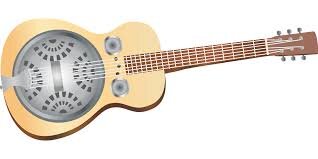
dobro.jpg

Lately, we’ve been talking about The Mountain Dulcimer and many believe this instrument was invented in the Appalachian mountains.  As I was researching that question, I bumped into the origins of the Dobro. 

As I read the origins of the Dobros, I was so fascinated that I wanted to share it with you.

Think back – before amps on instruments and microphones - think about barn dances and purely acoustic shows. Musicians of that era and those inclined to play in those venues were always on the lookout for a loud instrument – not because their music needed increased decibels to be appreciated, but because the crowd couldn’t hear a soft instrument.  I bought a used fiddle from an old musician and one of his selling points was, “it’s really loud”.   Turns out, when you play like me loud isn’t really a great thing – but that’s another story.

The dobro has come to mean a guitar-like instrument with a resonator built into it.  However, originally mandolins, fiddles and ukuleles were also produced with these resonators.

The sound of any stringed instrument must resonate against a sound board – in a piano it’s a large piece of brass, in a fiddle or acoustic guitar the sound resonates against a wooden sound board.  And as you might guess, the type of wood produces very different sounds – Fender) has a great article here that lists 7 different woods and the variations of sound to be expected from them.

There is, however, a limit to the volume of sound from a wooden sound board.  And then there was metal – aluminum to be specific.  Mr. George Beauchamp worked as a musician in Vaudeville shows and was looking for a way to amplify his stringed instruments. In the early 1920’s, he asked John and Emil Dopyera to turn their established, innovation skills to creating “resophonic” instruments.  In 1927 Mr. Dopyera filed a patent request for a guitar with three aluminum cones with a wooden saddle between them.

Even as amplified instruments became available, the dobro’s unique sound kept it on stages in the hands of country, bluegrass, jazz and blues musicians.

A Dulcimer by any other Name

If you’ve been reading The Stories any time at all, you know that my research often leaves me with more questions than answers and I’m always asking you readers to help me out.  So you can just imagine how excited I was to have a reader correct me on the origins of the dulcimer.

On December 18th I wrote that the Mountain Dulcimer was created in the Appalachians.  But one kind reader reminded me that the dulcimer is named in the Bible – in the Old Testament actually.  So that’s a long time before settlers arrived in these mountains.

The Dulcimer was played in Babylon more than 500 years before the birth of Christ.  Daniel 3:10 refers to a band which included, “…the sound of the cornet, flute, harp, sackbut, psaltery, and dulcimer, and all kinds of musick…” J. Vernon McGee says, “…this must have been a very famous orchestra…” because the instruments are listed three different times.

When three brave Israelites stood in defiance of the king’s order to bow before a great statue, the Babylonians had been playing dulcimers for about 20 years.  Maybe that’s part of why the famous orchestra was sure to name the instrument and why it’s remarked upon several times. 

Middle Eastern Bagpipe.jpg

I read my favorite Bible commentator who suggested that the “dulcimer” in the Bible was actually a pipe – maybe something like the Scottish bagpipes.  I found a really interesting article here at Britam.org that talked about Hebrew bagpipes used in Temple worship. This article names he instrument the “nabal“, but a search of my digital Bible returns Nabal only as the name of Abigail’s first husband.

hammered dulcimer.jpg

Now, the Hammered Dulcimer is actually a very old instrument as well, and one that is common in the Middle East – the lands of the Bible. The Smithsonian Institute says the hammered dulcimer dates to 900 A.D. However, it is believed to have come from the Psaltery which is also mentioned in the Bible (in that same text in Daniel as well as numerous times in Psalms).  Moreover, that group of zither instruments are known throughout history across both the Middle East and Far East.

Based on the research I did for the Mountain Dulcimer article, the basis for claiming it was invented in the Appalachians lies in the origins of the mountain musicians.  No one would have been surprised for a Scottsman to make a slight change to his beloved bagpipes, or an Irishman to add a string to his fiddle for a slightly different sound.  (The dobro is a prime example of this – hmm, maybe we should look more closely at that instrument.)  However, neither culture has an instrument similar to the little mountain dulcimer, held on your lap (sometimes it’s actually called a lap dulcimer) and strummed or picked like a guitar.

This is very confusing, isn’t it?

Once again, I find myself with more questions than answers.  Today we live in this show-me culture where you can find a video to explain everything from childbirth to tying your shoes.  That’s not what God chose to give us in His holy scripture.  In fact, there are things mentioned there that we can’t exactly define – like this dulcimer that played in ancient Babylon.  However, neither the individual instruments nor the band playing them are the focus of Daniel chapter 3.  Instead, it is the faith of three young Hebrew boys who refused to bow before a heathen statue and were rewarded by the pre-incarnate Jesus Christ joining them in a fiery furnace and eventually delivering them from that death sentence!  Whew, that makes me want to shout!

If you have any thoughts on this instrument, I’m always eager to hear them.  Just click “comments” below.


Merry Christmas

Merry Christmas dear Readers!

Christmas is always a great time to tell people that you appreciate them and I want all of you readers to know what a joy it is to share Tennessee Mountain Stories with you.

I never quite know how to express the feelings I have when you tell me you enjoy the blog, or that you’ve read one of my books. Every time I have a chance, I always try to tell you how honored I am that you would spend some of your precious time with me and please allow me to reiterate that to you now.

7 years and 4 books ago, I never would have imagined that yu’ns would keep listening to me. And I guess I still find it hard to believe. Still, there are stories left to tell, history to learn and share, and I look forward to continuing the effort in 2021.

I’m going to take a little break this last week of the year and will see you here again in January.

God Bless and Keep each of you and please have a Merry Christmas.

The Mountain Dulcimer

The Dulcimores, Crossville, TN

The Dulcimores, Crossville, TN

Several weeks ago, I was honored to participate in the Cumberland Horizons Heritage Day alongside a local band, The Dulcimores.  As I enjoyed the sweet tones from 5 different dulcimers I grew more curious about this uniquely American instrument whose music seems to echo a mountain breeze, trickling brook and singing bird; surely it was created for such a purpose.  So I talked with the musicians a little then dug around the web some and wanted to share with you what I’ve learned.

scheithold.jpg

Music is as old as time – it wasn’t by accident that God gave birds those beautiful songs!  Genesis 4:21 tells us that just 8 generations from creation, Jubal “…was the father of all such as handle the harp and organ.”  Today there are a myriad of instruments – many I could not name.   And, in fact, I can scarcely pronounce the predecessor of the dulcimer, the German scheitholt. 

And then there was the great melting pot known as America…this is where it gets exciting.

So German immigrants brought their scheitholt along with them when they settled in Pennsylvania, alongside the Scottish, the Irish, and those unique Scots-Irish who were somehow a people all their own.   The British Isles had no such instrument; The Scotts played their bagpipes, the Irish their fiddles – and as they searched for a home among the rugged Appalachian Mountains they merged the two sounds into an adaptation of something they saw their German neighbors playing.

I can’t help but imagine those early days when immigrants from across Europe flooded the US bring unique languages and cultures.  The Germans came speaking a wholly different language that would have completely isolated them into their own communities.  The Irish Gaelic and the Scottish Gaelic no doubt came with the immigrants, however after centuries of invasion, landlords and oversight by the English, those coming from Ireland and Scotland probably had that language in common.   Yet music knows no border.  We have had radio for so many decades and now we have streaming platforms and internet music – it’s hard to imagine not hearing a wide variety of music, hard to picture what it would be like to stand in this strange new land among peoples I might never have imagined and to hear a brand new instrument.

Dulcimer.jpg

These were unique people that I greatly admire.  They had something I’m pretty sure I lack – a drive to find something better, a willingness to take chances and face uncertainties and a work ethic that would allow them to survive extreme difficulties.  They also had an ingenuity that allowed them to sing the songs of their ancestors and play the music of their childhood – and they created a brand-new instrument to do it.  This instrument would be easy to learn – the dulcimer is said to be one of the quickest to master.  The dulcimer was portable, quiet and easily built from materials readily available in the mountains.  It is more than uniquely American – it is uniquely Appalachian!

Chincapin Nuts

The following article is re-posted from Backwoods Adventures. I’ve shared their articles a few times - Scott doesn’t blog very often but whenever he takes the time to share, I always learn something and I want to share it! He has been beyond gracious in allowing me to do so, as well as sharing pictures he brings back from his remote jaunts.

Just one note for you - I suppose this article was the first time I’ve ever seen the word CHINCAPIN in writing. We always call them “Chinky-pins” and I would’ve had to look it up to spell it correctly!


The American Chincapin

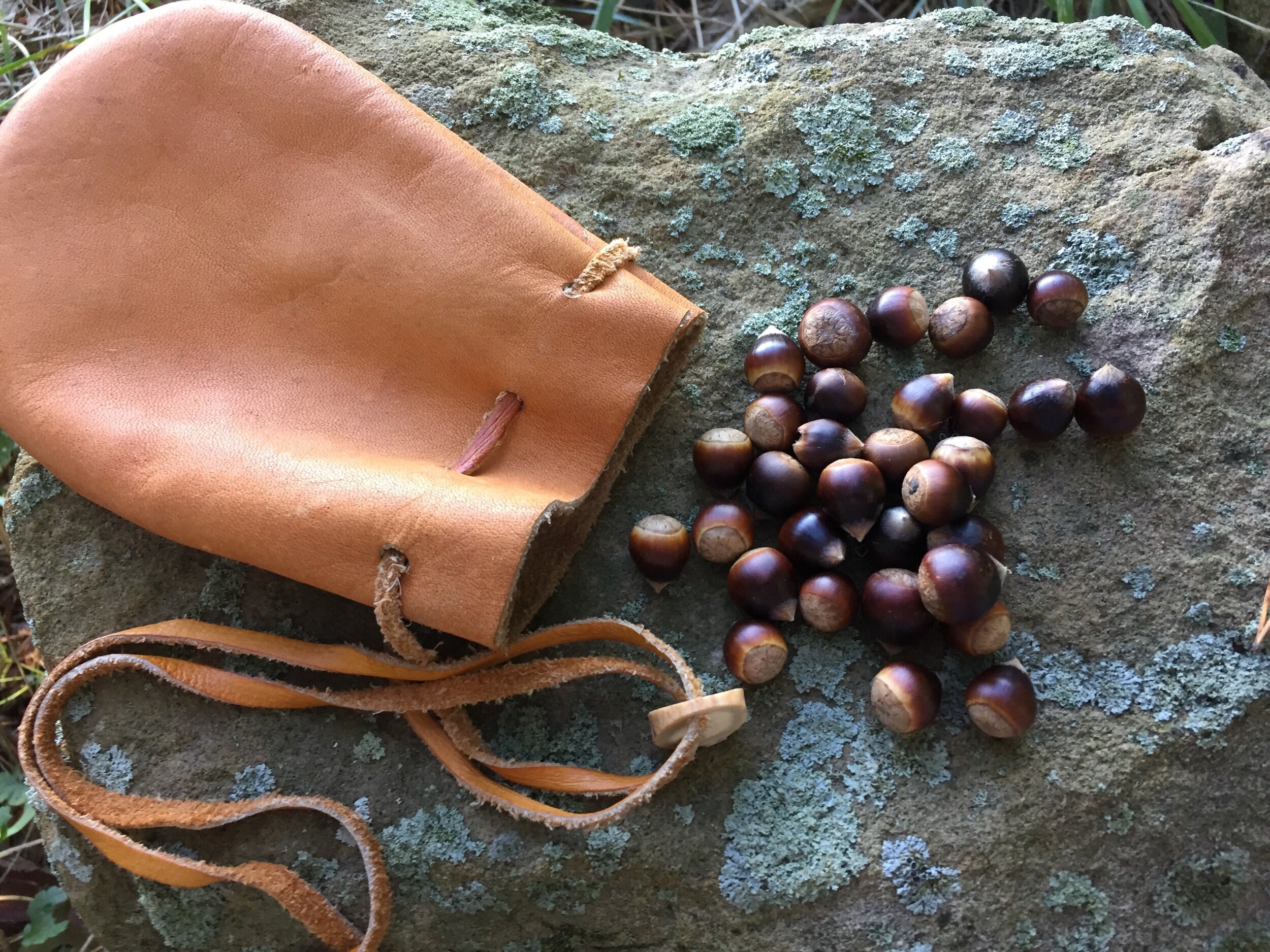
We recently ran across one of my favorite treats in the backcountry! A delicious wild nut called a Chinquapin.

The American Chinquapin (Castaneda pumila) is a “species” closely related to the chestnut although smaller. Also commonly known as the Allegheny Chinquapin or dwarf chestnut.

It is a deciduous tree found mostly in the eastern and southeastern United States. Sadly populations have declined over the last several year.

The Chinquapin tree can range in size from a small looking shrub to a small looking tree.

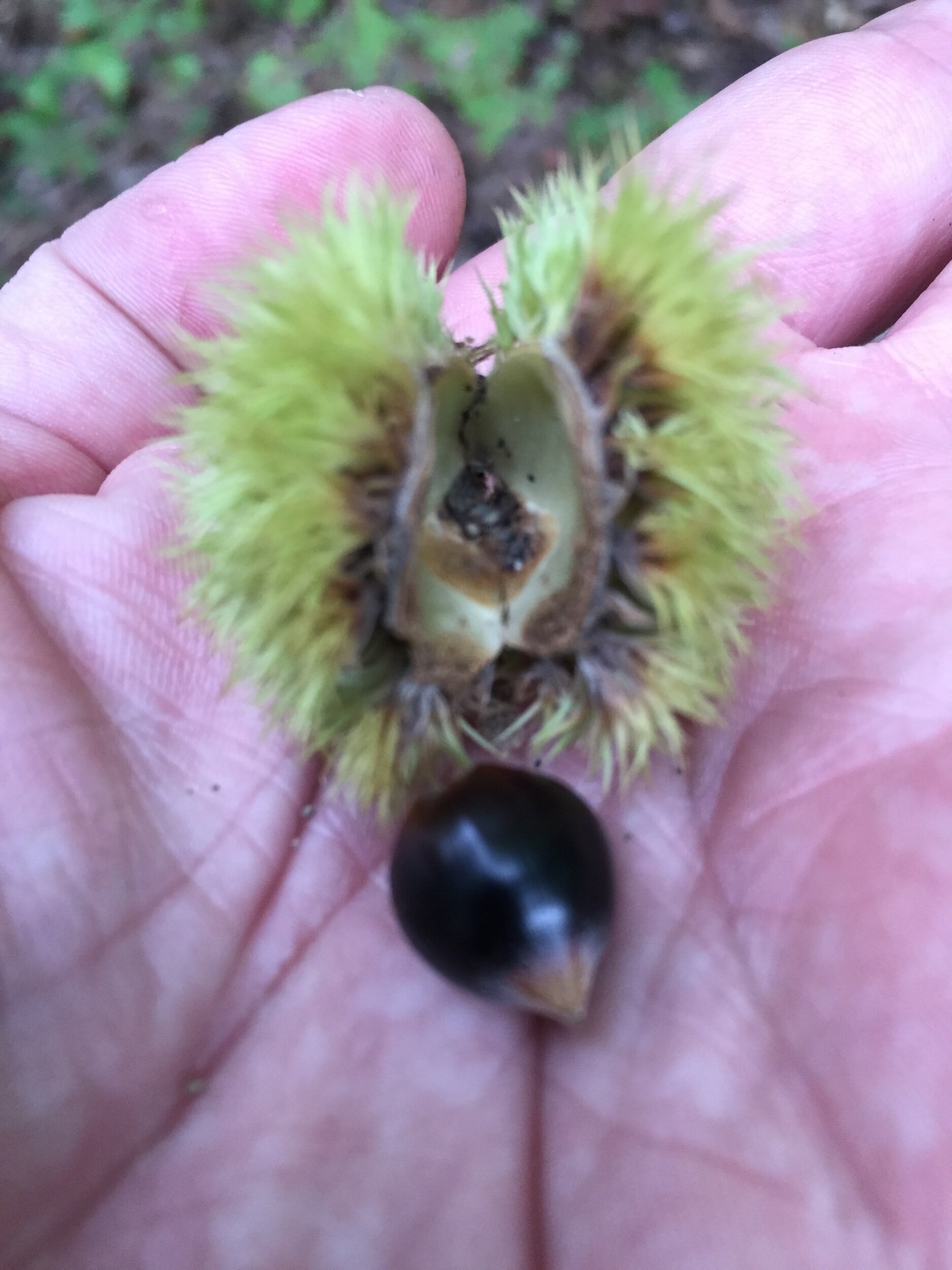
It’s nuts are edible and quite sweet when mature in the fall of the year. It has single seed burs. This means each burr that opens into two halves will have one small nut inside which gives the tree a distinctive chestnut look.

IMG_3410.jpeg

Legend has it that Captain John Smith not knowing what they were wrote the first European record of a Chinquapin in 1612. “The Indians have a small fruit growing on a little tree, husked like a Chestnut. This they call a “Checkinquamins”, which they esteem a great daintie.”